
Two years ago I was a stressed, exhausted, working-from-home vegan spending around two hundred dollars a week on convenience food. I want to say that out loud because I think a lot of plant-based eaters know exactly what I’m describing and have not heard anyone admit it. The two-meal-kit subscriptions. The frozen burrito stash. The fancy prepared salads from the natural grocery’s deli counter. The pre-cut vegetables. The vegan ravioli at twelve dollars a package. Add in a couple of takeout orders a week from the one good vegan-friendly restaurant in town, and you are easily clearing two hundred dollars before you’ve bought a single bag of rice.
I am not ashamed of that season. I was overwhelmed. My work was demanding, I had just brought a third dog into the house, and I genuinely did not have the bandwidth to figure out a sustainable food system from scratch. So I outsourced. The outsourcing kept me fed. But the math eventually got my attention, and so did the packaging, and so did the slow noticing that I felt worse the more pre-made food I ate. None of it was unhealthy in any specific way. It was just food that had been sitting in plastic for days, made by people I didn’t know, that I was paying a steep convenience premium for.
So I built a system. Not a meal plan in the rigid sense. A flexible repeating structure that lets me feed myself well, vegan, on a real budget, with minimal decision-making during the week. The numbers now: I spend somewhere between seventy-five and ninety dollars a week on groceries. That includes organic produce, a couple of treats, and pantry rebuilds. The savings, compared to my old life, are well over five hundred dollars a month. And I eat better. I want to walk you through the actual system, because the principles are more useful than any specific meal plan would be.
In This Article
Key Takeaways
- Convenience food costs three to four times what equivalent home-prepared meals cost.
- Build a system around components (grains, beans, vegetables, sauces) rather than specific recipes.
- Sunday prep of three core components covers most of the week without burnout.
- Always keep two emergency fallback meals stocked for crash days.
- Mindset shift: stop trying to cook from scratch every night; start assembling.
The Math That Finally Got My Attention
I want to lead with the numbers because they were what finally moved me. The USDA’s monthly food plan cost reports show that for a single adult woman, the “moderate-cost” food plan runs roughly $290 to $350 per month. I was spending close to nine hundred. The gap was not about food; the gap was about packaging, prep labor, brand mark-ups, and delivery fees on someone else’s food.
Convenience food’s per-meal cost is hard to look at directly. A pre-made vegan grain bowl from the natural grocery deli runs eleven to fourteen dollars. The same bowl made from components at home costs roughly two-fifty to three-fifty depending on the season. That ratio holds across nearly every prepared vegan product I’d been buying. Three to four times the cost, every time, for someone else to assemble what I could assemble in twenty minutes.
The Vegan Society and Plant Based News have both noted that whole-foods plant-based eating is one of the most affordable ways to eat well, while highly processed plant-based products and prepared meals are among the most expensive. The economics of veganism, in other words, fork sharply depending on where in the food chain you buy. I had been buying entirely at the expensive end without realizing it.
The math became motivating. Not in a guilt way. In a “the money has to be going somewhere; let me actually choose where” way. I wanted the savings going to my senior dog’s medical care fund, to my volunteer work, to my home. Not to the deli counter.
The Mindset Shift That Made the System Possible
The biggest shift was not technical. It was psychological. I had been trying to cook from scratch every night, which never worked, which made me feel like a failure, which sent me back to the deli counter. The system had to break that loop.
The reframe: I am not cooking from scratch. I am assembling meals from components I prepared on Sunday.
This is a small mental shift that changes everything. Cooking implies starting from nothing each night and creating a meal. Assembling implies pulling four or five prepared things from the fridge and combining them. Assembling takes seven to twelve minutes. Cooking from scratch takes forty-five. Most weeknights I do not have forty-five minutes. Most weeknights I do have twelve.
The second reframe: The same components can become different meals. A pot of cooked grain, a pot of cooked beans, a tray of roasted vegetables, and two sauces can produce: grain bowls, salads, wraps, soups (add broth), and pasta sauces (add tomato paste). I am not eating the same meal five times. I am eating five meals that share components.
Once I stopped trying to be a chef and started trying to be a smart assembler, the whole thing became sustainable.
The Weekly Structure: Components, Not Recipes
Here’s the structure I prep on Sundays and assemble from during the week.
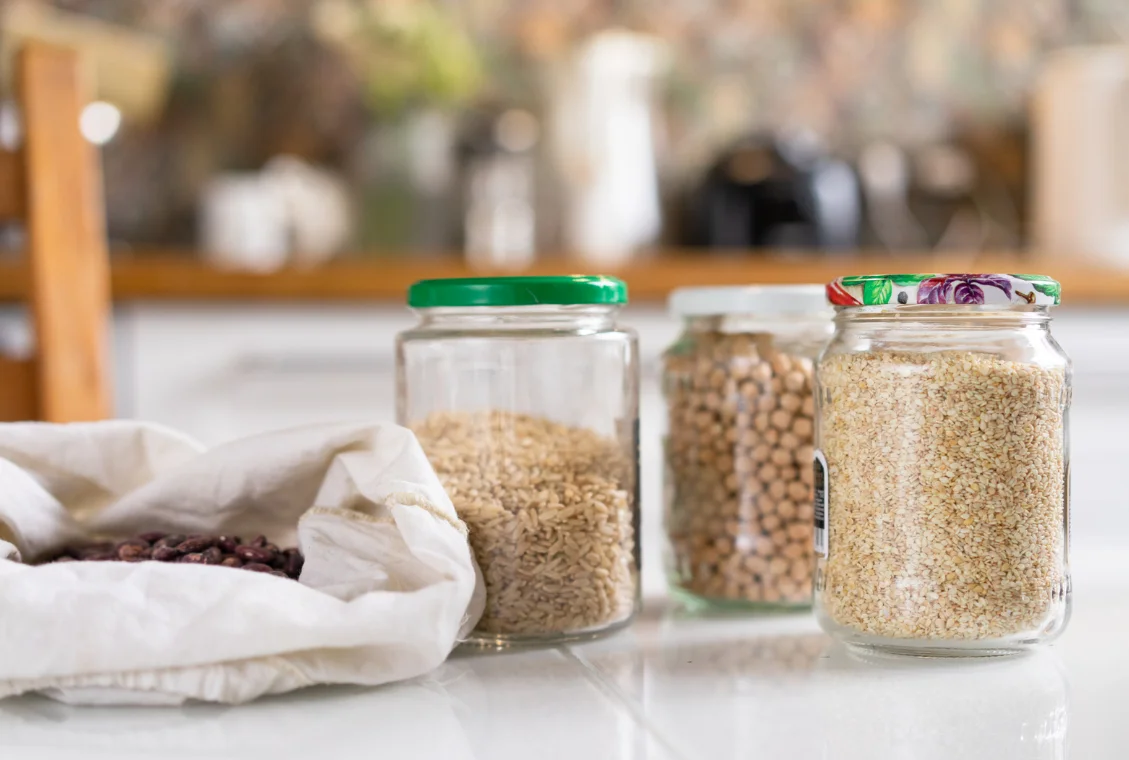
One pot of grain
Brown rice, farro, or quinoa. I rotate. About four cups cooked, which gives me eight servings. Stays good in the fridge for five days, can be frozen in single-serving silicone bags for the back end of the week.
One pot of beans or lentils
Sometimes chickpeas, sometimes black beans, sometimes red lentils, sometimes white beans. I cook from dry once or twice a month for the major batch and supplement with canned for fast meals. About three cups cooked.
One tray of roasted vegetables
Whatever’s in season. A large sheet pan, two vegetables minimum, tossed with olive oil and salt and roasted at 425 for about thirty minutes. Sweet potatoes plus broccoli, or cauliflower plus carrots, or beets plus brussels sprouts. The combinations don’t matter much. The point is to have roasted vegetables waiting in the fridge.
One big batch of raw vegetable prep
Shredded cabbage and carrots. Or sliced cucumber and bell pepper. Or chopped kale that I massage with a little olive oil and lemon. Something raw and crunchy to add freshness to any meal.
Two sauces
This is the secret weapon. Two sauces, made fresh each Sunday, transform plain components into actual meals. My standards:
- A creamy tahini sauce: tahini, lemon, garlic, water, salt. Whisked together. Lasts a week.
- A bright vinaigrette: olive oil, apple cider vinegar, dijon, maple syrup, salt. Shaken in a jar. Lasts a week.
I rotate the sauces too. Sometimes it’s a peanut sauce and a salsa. Sometimes it’s a cashew cream and a chimichurri. The variety prevents the meals from feeling repetitive.
The Shopping List That Repeats
The shopping list barely changes from week to week. Here is roughly what I buy:
Pantry staples (rotated as needed)
- Dried beans (rotating variety)
- Whole grains (rotating between farro, brown rice, quinoa)
- Rolled oats for breakfast
- Canned tomatoes
- Canned beans (for backup)
- Tahini, olive oil, vinegar, soy sauce
- Nutritional yeast
- Onions, garlic, ginger
Weekly fresh
- One large bunch of leafy greens (kale or chard)
- Two pounds of mixed vegetables for roasting (whatever’s in season)
- One head of cabbage or two cucumbers for raw prep
- Carrots
- Lemons
- One bunch of fresh herbs
- One avocado, sometimes two
- A small container of berries or seasonal fruit
- Bread (sourdough, usually a half loaf)
Treats (varies)
- Dark chocolate (vegan)
- One specialty item I’m curious about: a fermented vegetable, a new sauce, something seasonal
That’s roughly the list. Total cost most weeks: seventy-five to ninety dollars depending on what I’m restocking from the pantry side. I shop mostly at one natural grocery store with a good bulk bin section, supplemented by the refill store for cleaning supplies (a separate budget).
Sunday Prep Day, Specifically
Sunday prep takes me about an hour and a half. I do it while listening to a podcast or an audiobook, with one of the dogs at my feet. It’s not a productive grind. It’s a meditative weekly ritual that I look forward to.
The sequence:
- Turn the oven on to 425 to preheat.
- Start the grain cooking on the stove (water, salt, grain, lid on, timer set).
- Start the beans on a back burner if cooking from dry.
- Chop vegetables for the roasting tray. Toss with oil and salt. Put in the oven.
- Prep the raw vegetables (shred, slice, chop) and put them in a sealed container.
- Make the two sauces. This takes maybe ten minutes total.
- When the grain finishes, fluff it and let it cool. Put it in a glass container.
- When the roasted vegetables finish, let them cool. Put them in another glass container.
- When the beans finish, drain and cool.
- Wipe down the kitchen. Stack the containers in the fridge so I can see them.
End state: my fridge has five clearly visible containers: grain, beans, roasted vegetables, raw vegetables, sauces. The whole week of dinners is pre-staged. Decision-making at six o’clock on a Wednesday goes from “what am I going to eat” to “what shall I assemble.” That distance is everything.
What Weeknight Meals Actually Look Like
Here are the actual meals I made one week last month, all from the same component prep:
Monday: Grain bowl with brown rice, chickpeas, roasted sweet potatoes and broccoli, raw shredded cabbage, drizzled with tahini sauce. Topped with avocado.
Tuesday: Same components, but I rolled them into a large flatbread wrap with the vinaigrette drizzled inside and ate it for dinner with a side of fruit.
Wednesday: A quick soup. I sauteed garlic and onion, added a can of crushed tomatoes and a cup of vegetable broth, threw in the chickpeas and some roasted vegetables, simmered for ten minutes, served over a small portion of leftover rice.
Thursday: A bigger salad, the raw vegetables piled high, with chickpeas and a smaller amount of grain on top, dressed with the vinaigrette, served with toasted sourdough.
Friday: Pasta night, but cheating. I cooked pasta from a box, tossed it with the remaining roasted vegetables and some pesto from the freezer, topped with nutritional yeast.
Five different meals. One component prep. The variety came from how I assembled, not from cooking five different recipes. Cleveland Clinic’s nutrition guidance emphasizes that a varied plant-based diet built around whole foods is associated with strong long-term health outcomes, and the component approach makes that variety easy to actually achieve.
The Fallback Plans for Hard Days
Some days I am too tired or too busy to even assemble. The system has to account for these days or it collapses. I keep two emergency fallbacks stocked at all times.
Emergency fallback one: pantry pasta. A box of pasta, a jar of marinara, a can of white beans, and a handful of frozen spinach. Takes twelve minutes start to finish. Always have all four ingredients in the house.
Emergency fallback two: a really good frozen burrito. I keep a small stash from one specific brand that is fully vegan and has a quality I trust. On the truly bad days, I eat one with hot sauce and a sliced avocado and call it dinner without shame. The trick is making sure these stay emergency-only, not slipping back to a default.
The point of the fallback is to never face a hard day without options. The old version of me would have, in a bad-day moment, ordered takeout for twenty-six dollars and felt low-grade defeated. The new version of me has a twelve-minute pasta in the pantry. The dollar gap on a single bad day is twenty-something. Over a month of occasional bad days, the math compounds.
A Last Note
I am not a great cook. I want to say that clearly. The system above is not for chefs. It is for tired, busy, overwhelmed vegans who care about eating well, want to spend less, and don’t have the bandwidth to cook from scratch every night. If that’s you, this works. I have lived inside it for two years now, in my Michigan kitchen, after sustained-stress weeks and after relaxing weeks and after travel weeks, and it has held up across all of them.
The savings are real. The food is better. The packaging is dramatically reduced. The mental load on weeknights is gone. The cooking, when I do it, is on Sunday with a podcast on, not Tuesday at six o’clock with nothing in the fridge.
If you’re stuck in the prepared-food spiral and the math is starting to bother you, the move is not to suddenly become a chef. The move is to become a smart assembler. Pick one Sunday. Cook one pot of grain, one pot of beans, one tray of vegetables, one raw prep, and two sauces. Make five different meals from them that week. See what you spend. See what you save. See how you feel.
I promise you that the second Sunday is easier than the first. The third Sunday, you stop thinking about it. By the fifth Sunday, you have a system that runs itself. And then, somewhere around the fourth month, you’ll look back at how you used to eat and laugh at the version of yourself who thought twelve-dollar grain bowls were the only way to be vegan and busy at the same time. That version of me is hilarious in retrospect. She just didn’t know yet.
Sources
- USDA Food Plans: Cost of Food Monthly Reports, U.S. Department of Agriculture.
- Plant Based News, Plant Based News.
- Plant-Based Nutrition, Cleveland Clinic.
- The Vegan Society, The Vegan Society.
The Free Subscriber’s Library Is Open
Join Peacefully Proven for a growing collection of free wellness tools, guides, and printables, plus a guided forest bathing meditation to begin. All yours, always free.





Join the conversation and add your thoughts.