
I counted the plastic in my pantry one Saturday morning in February. Not because I thought I had a problem, but because I’d just listened to a podcast on microplastics over breakfast and felt suddenly very aware of the bag of lentils I was pouring out of. I started pulling things off the shelves. Bag of rice. Bag of black beans. Bag of rolled oats. Sleeve of crackers. Bag of nutritional yeast. Tub of nut butter. Sleeve of pasta. Bag of trail mix. Pouch of dried apricots. I made a pile on the counter and stopped counting at thirty-seven plastic-packaged items.
I had thought of myself as a relatively low-waste person. I bring my own bags to the grocery store. I compost. I have not bought a plastic water bottle in years. And still, thirty-seven plastic-packaged items in one small pantry. The math of it sat with me for the rest of the day.
So I gave myself an experiment. Thirty days. As I ran out of each plastic-packaged staple, I would try to replace it with something better, or do without. I would track what I tried, what worked, what didn’t, and what cost me more or less. I would not throw away the plastic I already had, that would be silly, the plastic is already in my house. The point was the next purchase, not the current one. Six months later, I can tell you exactly what stuck, what quietly came back, and what was never going to work in the life I actually live. Here’s the honest report.
In This Article
Key Takeaways
- A 30-day experiment is long enough to learn a lot and short enough to actually finish.
- Bulk bin staples, grains, beans, nuts, seeds, were the easiest and most durable swaps for me.
- Crackers, frozen food, and snack items were the hardest categories to fully convert.
- The cost difference was smaller than I expected once I bought in larger quantities.
- Six months later, about 60 percent of the swaps stuck. That’s still real progress.
Why I Did This (And Why It’s Not About Perfection)
I should say up front that I have no interest in zero-waste perfectionism. I have watched friends spiral into shame about a single plastic wrapper and quit the whole effort, and I think that’s the worst possible outcome. The point of this kind of experiment, for me, is to learn what’s actually possible in my life, a single person in a Michigan house who works from home, who is vegan and cooks most meals, who does not have a garden, and who drives infrequently enough that the grocery store is a real trip, not a daily stop.
The reason any of this matters is the scale of plastic in the food system. The EPA’s most recent municipal solid waste data, summarized on the agency’s plastics material-specific page, estimates that Americans generated 35.7 million tons of plastic waste in a single year, with food packaging a major contributor. Of that, only about 8.7 percent was recycled. The rest was landfilled or incinerated. Personal swaps are not the whole answer, that’s structural, but they’re not nothing, and they teach you what’s possible.
The other thing I noticed once I started reading: microplastics show up in food, in water, in tea bags, in our own bodies. A 2024 piece from Consumer Reports walking through how to reduce microplastic exposure made me especially aware of plastic that holds hot food, oily food, or food that sits on a shelf for months. I started prioritizing those swaps first. That ended up being the right instinct.
The Swaps That Stuck
Six months in, these are the swaps I made during the 30-day experiment that I am still doing, with no friction, every single grocery trip.
Rice, beans, and lentils, bought in bulk
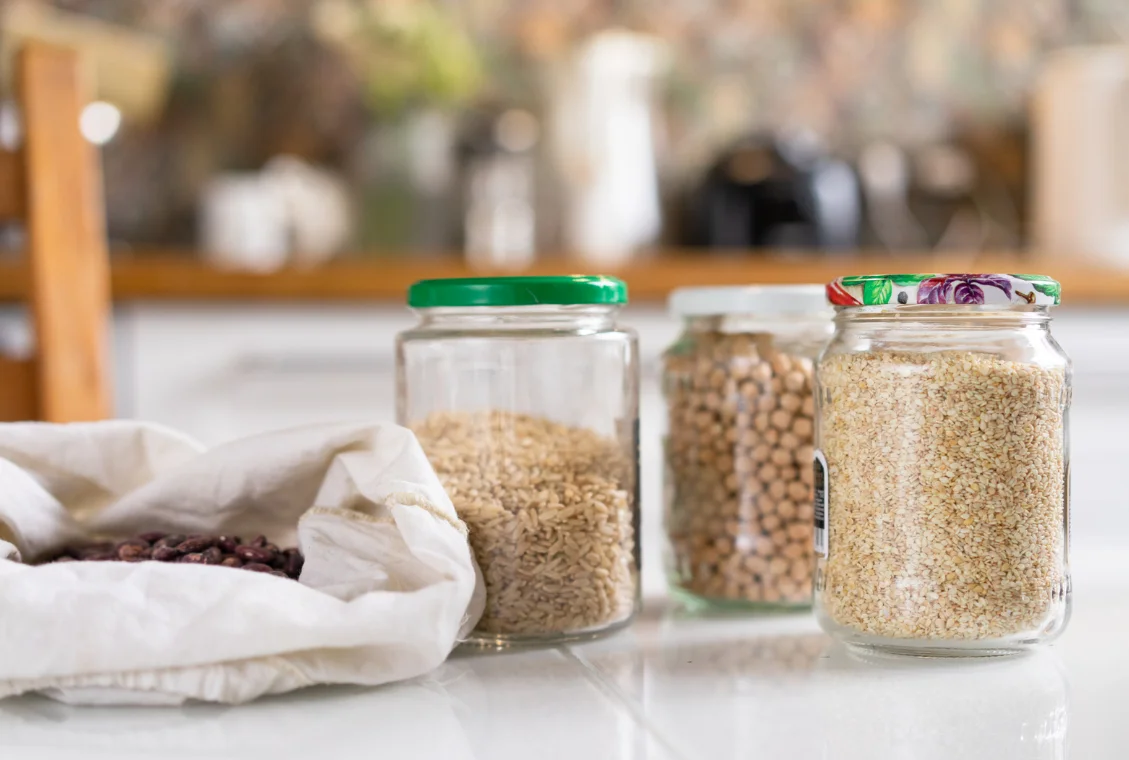
I refill three large glass jars at the bulk bins for jasmine rice, black beans, and green lentils. These are my three most-used pantry staples as a vegan, and they all keep effectively forever in glass. The bulk bin prices have actually been slightly lower than the bagged equivalents at my regular grocery store, and the quality has been at least as good.
Rolled oats
Same routine, same glass jar. I eat oats most mornings. The bulk version costs less than the canister version, tastes the same, and I no longer have a stack of cardboard-and-foil canisters to deal with.
Nuts and seeds
Almonds, walnuts, pumpkin seeds, sunflower seeds, hemp hearts. All bulk. All glass-jarred at home. This was the swap that surprised me most, I’d assumed bulk nuts would be more expensive than the pre-packaged bags. They were actually less, and noticeably fresher. I think I was buying old nuts in bags for years and didn’t realize it.
Nutritional yeast
If you’re not vegan, nutritional yeast is a flaky, savory, cheese-tasting topping vegans use on basically everything. I used to buy it in plastic tubs. The bulk version is half the price and tastes better. This is now the swap I evangelize most aggressively to other vegans.
Pasta from boxes, not bags
This is a small one but it matters to me. Plastic pasta bags are basically unrecyclable. Cardboard boxes are. I switched to boxed pasta and never looked back.
Spices in bulk, refilling glass jars
Most plastic spice jars are tiny and add up fast. I now refill the same set of small glass jars at the bulk spice bins. The spices are usually fresher (bulk turnover is higher) and a fraction of the cost.
The Swaps That Failed
Now the honest part. Six months in, here are the swaps that didn’t last.
Crackers
I tried. I really did. I made my own seed crackers for two weeks. They were fine. But they took forty-five minutes of active time and a hot oven, and after the experiment ended I quietly went back to buying my favorite brand of crackers, which come in a plastic-lined bag. I have not figured out a non-plastic cracker option that fits my life. I have made peace with this.
Plant milks
I tried making my own oat milk and almond milk at home. The oat milk turned out slimy no matter how cold the water was or how briefly I blended it. The almond milk required straining through a nut milk bag and produced almond pulp I never managed to use up. After two weeks of trying, I went back to buying shelf-stable plant milk in cartons. The cartons are at least partly recyclable and the convenience math was overwhelming.
Frozen vegetables
I love frozen vegetables and rely on them. The plastic bag is essentially unavoidable. I looked at every option in my store. The few brands selling in cardboard cost two to three times as much, and the cardboard was lined with plastic anyway. I let this one go.
Tortillas
Same issue. Every tortilla I’ve found comes in plastic. I tried making them at home a couple of times. They were fine but took thirty minutes, and I don’t eat tortillas often enough to bake them in batches. Plastic-bag tortillas remained in my life.
The Swaps That Half-Stuck
These are the ones I do sometimes, depending on the week.
Flour
When I’m being intentional, I refill from the bulk bin. When I’m in a hurry, I grab a paper bag of King Arthur from the regular aisle. Both work. Both are paper or paper-equivalent. I don’t beat myself up about this one.
Nut butter
My grocery store has a peanut butter grinder where you can fill your own jar. When I have the time and remember to bring an empty jar, I use it, and the peanut butter is better than any I can buy. When I forget or I’m in a hurry, I buy the glass-jar version. Either way, no plastic tubs anymore. That swap fully stuck. The grind-your-own bonus is occasional.
Tofu
Most tofu comes in plastic. There are a couple of brands that come in cardboard cartons with minimal plastic film. I buy those when my store has them in stock. When they don’t, I buy the regular plastic tub and rinse and recycle what I can. The Environmental Protection Agency’s guidance on common recyclables reminded me that contamination is one of the biggest reasons “recyclable” plastic ends up in landfills. Clean is the magic word.
Dried fruit
Bulk dried fruit is amazing when my store has it. Sometimes they don’t. When they don’t, I buy the bagged version. I have learned not to make this a moral issue.
The Real Cost Math
I tracked my grocery spending closely during the 30 days and for the three months after. Here’s what I learned.
Bulk staples, grains, beans, lentils, oats, nuts, seeds, spices, were measurably cheaper than the packaged equivalents. Not by huge margins, but reliably. Over a year, the savings on these alone roughly covered the cost of the glass jars I bought to store them in (which I bought once and will use indefinitely).
Specialty items in glass, fancy peanut butter, salsa, pasta sauce, were sometimes more expensive than the plastic-tub versions. Sometimes the same. Almost never cheaper. I have decided that the small premium on a few items is worth it to me, but I want to be honest about it. Plastic-free is not always free.
Time was the bigger cost than money, especially in the first few weeks. Refilling jars at the bulk bin takes a few extra minutes. Bringing the jars home means cleaning and refilling them. None of this is hard, but it’s all new behavior that adds up before it becomes routine. By month two it was background. By month six it was just how I shop.
The Natural Resources Defense Council notes that the food packaging industry produces around 40 percent of all plastic in the U.S., and that single-use plastics are the fastest-growing segment. Anything I do as a consumer is a drop in that bucket. But it’s also one less drop going into it, repeated week after week.
What I’d Tell Someone Starting Now
If you’re thinking about doing your own version of this, here’s what I’d offer based on six months of hindsight.
Start with what you already buy most often. The biggest impact swaps for me were rice, oats, beans, and nuts because I eat those things constantly. If I’d started with something I buy three times a year, the savings and the habit wouldn’t have built. Look at your grocery list and pick the top five most-used staples first.
Buy the jars before you need them. I spent the first week of the experiment scrambling to find storage. Now I have a permanent set of glass jars with lids, sixteen-ounce, thirty-two-ounce, and sixty-four-ounce sizes, and refilling is fast because the system is set up. I bought most of mine at a thrift store for under a dollar each. You do not need fancy specialty containers.
Find a store with real bulk bins. This is the make-or-break factor. If your nearest grocery store doesn’t have bulk bins, this is going to be hard. In my area, the food co-op and a couple of natural grocery chains have the best bulk sections. The Plastic Pollution Coalition keeps an overview of where to find bulk bins that’s worth checking against your area.
Let yourself fail on some categories without guilt. The plastic-bag tortillas and the crackers were never going to work in my actual life. Naming that and moving on freed me to actually keep doing the swaps that worked. Perfectionism would have stopped me at week three.
Track what you’re doing. A simple list, what you swapped, when, whether it stuck, taught me more in 30 days than I’d learned in years of vaguely caring about plastic. Data beats intention.
A Last Note
My pantry now has glass jars where there used to be plastic bags. Not all of them. There’s still plastic in my kitchen, frozen vegetables, tortillas, a bag of crackers, a sleeve of vegan butter. The bulk bin staples sit in clear jars on open shelves and they look beautiful, which is a small daily pleasure I didn’t expect.
The thirty-day experiment is over. The habits it built are still here. About 60 percent of the swaps I tried stuck. That’s not perfection. It’s not zero waste. It is, however, real change, accumulated week after week, in the only place I have actual control: my own kitchen.
If you’ve been wondering whether something like this is worth trying, my honest answer is yes, with two caveats. Start small. Let yourself learn what doesn’t work without quitting. The version of plastic-free that lasts in your life is the version your life can actually hold. Build that one.
Sources
- Plastics: Material-Specific Data, U.S. Environmental Protection Agency.
- How to Reduce Your Exposure to Microplastics, Consumer Reports.
- Single-Use Plastics 101, Natural Resources Defense Council.
- Zero Waste Grocery Shopping: Where to Find Bulk Bins, Plastic Pollution Coalition.
- How Do I Recycle?: Common Recyclables, U.S. Environmental Protection Agency.
The Free Subscriber’s Library Is Open
Join Peacefully Proven for a growing collection of free wellness tools, guides, and printables, plus a guided forest bathing meditation to begin. All yours, always free.





Join the conversation and add your thoughts.