
My breakfast in my thirties was a piece of fruit and whatever else I could grab. My breakfast in my forties was a smoothie I made too quickly and drank standing up. My breakfast now, in my fifties, in menopause, on HRT, is one of three specific vegan variations I rotate week by week, sit down for, and treat as the most important meal of my day. The shift happened because the old approach stopped working. Skipping or under-fueling breakfast had different consequences at forty-five than it had at thirty, and by the time I was in late perimenopause, the consequences had become impossible to ignore.
This article walks through what those three breakfast variations are, why each one earned its place in the rotation, and how the rotation itself, more than any single recipe, has carried me through one of the most physiologically unsettled stretches of my adult life. I am not a registered dietitian. I am a woman who has been eating vegan for years, who tracks how she feels carefully, and who has spent enough time reading the actual research on menopause and nutrition to know what’s worth doing and what’s mostly noise.
Breakfast turned out to be one of the things worth doing. Here’s the version that worked for me.
In This Article
Key Takeaways
- Menopause changes the breakfast math: protein and fiber matter more than they used to.
- Three rotating variations cover different nutritional bases and prevent palate fatigue.
- 25-30 grams of plant protein at breakfast is a useful target for midlife women.
- Each variation hits a hormone-supportive nutrient: omega-3s, calcium, iron, or magnesium.
- The rotation is the system. The recipes are interchangeable within it.
Why I Rotate Instead of Eating the Same Thing Every Day
For about two years in early perimenopause I ate the exact same breakfast every single morning. It was a peanut-butter-banana smoothie and it was fine, until it wasn’t. I got bored of it. I started skipping breakfast on the days I couldn’t face it. I noticed I was missing certain nutrients I knew I should be getting. And I realized that one breakfast, no matter how good, was both psychologically and nutritionally narrow.
The rotation solved both problems. Three variations give me enough variety that I never dread breakfast, and they let me cover different nutritional bases across the week. One is omega-3 forward, one is iron and protein forward, one is a high-protein meal-replacement formulation I use on the busiest mornings. Across a week, I hit everything I want to hit.
The Academy of Nutrition and Dietetics has written that dietary variety is correlated with broader micronutrient adequacy, particularly in restrictive eating patterns like veganism. Eating the same breakfast every day might be efficient, but it tends to mean missing the same nutrients every day. The rotation is just enough variety to prevent that.
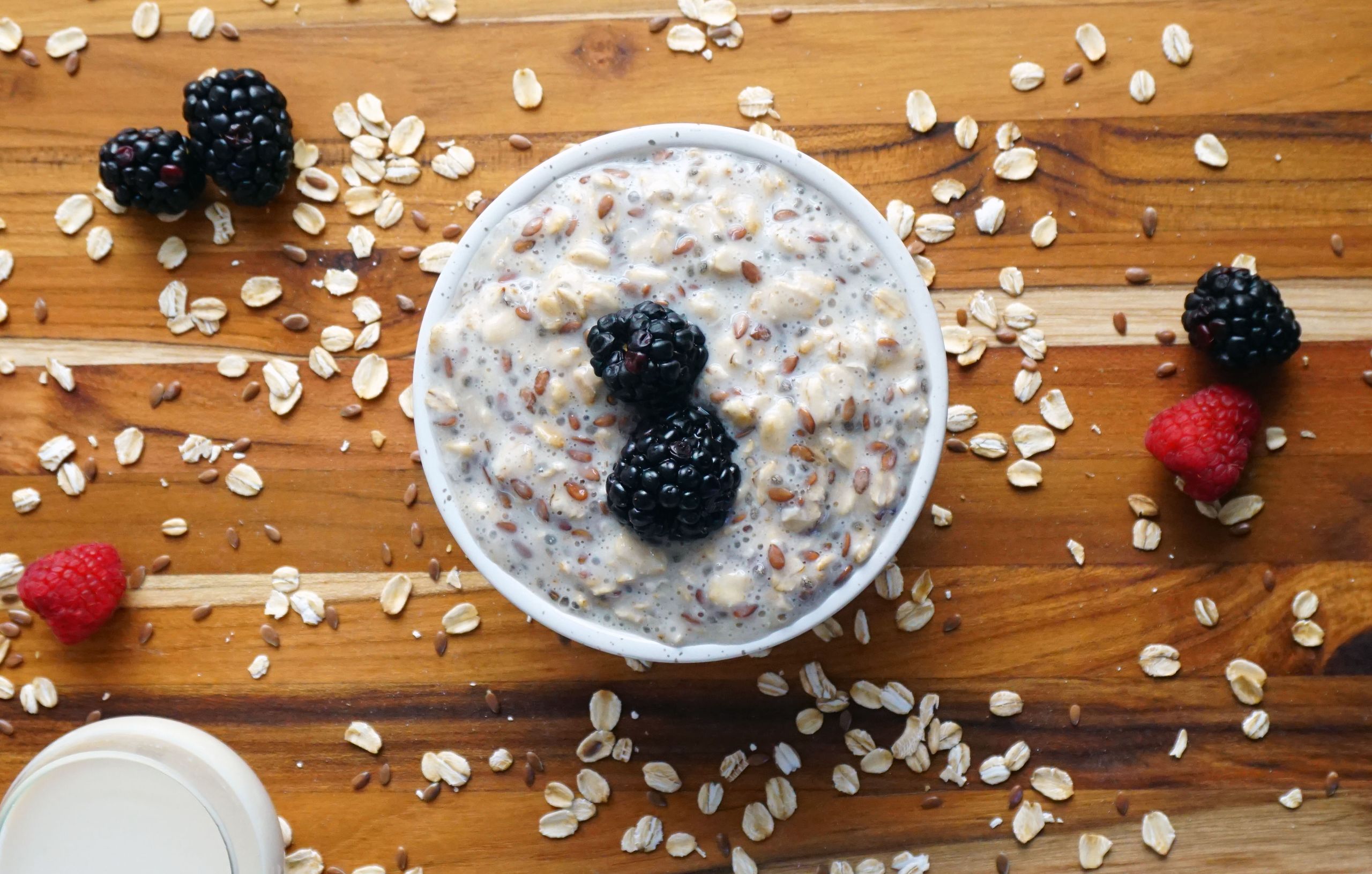
Variation 1: Overnight Oats With Walnuts and Berries
This is the breakfast I make on Sunday night and have ready in the fridge for Monday and Tuesday mornings. It takes four minutes to assemble the night before.
What’s in it:
- 1/2 cup organic rolled oats
- 1 cup unsweetened soy milk
- 2 tablespoons chia seeds
- 2 tablespoons ground flaxseed
- 1/4 cup walnut halves
- 1/2 cup organic blueberries (frozen is fine)
- 1 tablespoon hemp hearts
- A small drizzle of pure maple syrup
- A pinch of cinnamon
I assemble it in a wide-mouth mason jar, screw the lid on, and put it in the fridge. In the morning I take it out, stir, and eat.
Why it earned its spot: This is my omega-3 and fiber breakfast. Walnuts, flax, and chia together deliver around 8 grams of plant omega-3 ALA, and the soy milk contributes complete protein plus isoflavones. The North American Menopause Society has noted that soy isoflavones may modestly reduce hot flash frequency in some women, and the regular intake provided by a daily cup of soy milk is the form that’s been most studied. The blueberries provide anthocyanins and a slow carbohydrate base. The oats provide beta-glucan fiber, which supports both cholesterol and post-meal blood sugar.
Total protein: about 25 grams. Total fiber: about 18 grams. The combination keeps me full from 7:30 AM until I take my first desk-snack scoop at 11.
Variation 2: Savory Chickpea Scramble With Greens
This is my Wednesday and Thursday breakfast. It takes ten minutes in a skillet, which is the most I’m willing to spend on breakfast on a workday.
What’s in it:
- 1 cup mashed organic chickpeas (or chickpea flour batter, see note)
- 2 cups baby spinach or chopped kale
- 1/4 cup nutritional yeast
- 1/2 teaspoon kala namak (black salt) for an eggy flavor
- 1/2 teaspoon turmeric
- 1/2 teaspoon garlic powder
- 1 tablespoon olive oil
- 1/4 cup hemp hearts sprinkled on top
- 1 slice sprouted whole grain toast on the side
Sometimes I use mashed chickpeas straight from a can; sometimes I make a chickpea flour batter (a runny pancake batter) and cook it like scrambled eggs. Both work. The kala namak is the magic ingredient, sulfurous black salt that gives the dish a genuinely eggy flavor without any actual eggs.
Why it earned its spot: This is my iron and folate breakfast. Chickpeas are a strong plant source of iron, and the spinach or kale adds both iron and folate. The Vegan Society notes that plant iron is better absorbed when paired with vitamin C, so I sometimes add a slice of orange on the side or a squeeze of lemon over the greens. The nutritional yeast adds B-vitamins and a savory depth that makes this taste like a real breakfast and not a virtue project. The turmeric and olive oil contribute anti-inflammatory compounds. Total protein is about 28 grams.
I started including this variation when I noticed that my iron was on the low end of normal at an annual check, which is common in vegan women and particularly common in perimenopause when periods can become heavier before they stop. The Academy of Nutrition and Dietetics has consistently emphasized that vegan women need to attend to iron, B12, calcium, and vitamin D, and that breakfast is a useful place to load some of those nutrients first thing.
Variation 3: Kachava With Almond Butter and Flax
This is my Friday breakfast, and the breakfast I rely on for volunteer days when I need protein fast and the morning is compressed.
What’s in it:
- 2 scoops Kachava (chocolate or vanilla)
- 1.5 cups unsweetened soy milk
- 1 tablespoon almond butter
- 1 tablespoon ground flaxseed
- 1 tablespoon hemp hearts
- 1/2 frozen banana
- A small handful of frozen organic strawberries
- 1/2 teaspoon ceremonial cacao powder
I blend it for about 45 seconds, drink it from a glass, and I’m done. From start to finished smoothie, this is a five-minute breakfast.
Why it earned its spot: Kachava is a plant-based meal replacement with around 25 grams of protein per two-scoop serving plus a broad nutrient base. I treat it the way other people might treat a protein shake, as the engineered backbone of a meal that I then build up with whole foods. The almond butter and flax add fats and fiber. The banana and strawberries add slow carbohydrate. The hemp hearts and ceremonial cacao add minerals and a small lift in mood. Total protein after the additions is about 32 grams.
The reason this stays in the rotation is that some mornings I need breakfast to be fast and dense, and Kachava is the most reliable way I’ve found to do that without losing protein quality. The Physicians Committee for Responsible Medicine has written about the importance of complete plant proteins for midlife women, and a daily Kachava-anchored breakfast covers a significant share of weekly amino acid needs.
Why 25 Grams of Protein Is My Floor
I aim for at least 25 grams of protein at breakfast, every day, and ideally closer to 30. This is significantly more than I aimed for in my forties. Here’s why the math changed.
The Harvard T.H. Chan School of Public Health Nutrition Source has summarized the emerging evidence that older adults benefit from higher protein distribution across meals than younger adults, especially to support muscle synthesis, satiety, and metabolic health. Twenty to thirty grams at each meal is the rough target the literature converges on.
For menopausal women, this gets more pointed. Declining estrogen is associated with accelerated loss of muscle mass and bone density. The North American Menopause Society has emphasized that resistance training and adequate protein are the two most reliable interventions for protecting lean mass and bone through menopause. Twenty-five grams at breakfast is not optional for me anymore; it’s the floor.
For a vegan, hitting that floor at breakfast requires intention. A bowl of oatmeal with fruit gives you maybe 6 grams. Adding hemp, soy milk, walnuts, and seeds takes it to 25. The math is doable, but it requires building it in deliberately. All three of my variations are designed around hitting this number.
What Shifted After a Year of Doing This
The first thing was hunger. I stopped feeling that 10:30 AM gnawing that used to derail my mornings. With 25+ grams of protein and 15+ grams of fiber at breakfast, I now go cleanly to lunch without spiking or crashing.
The second thing was hot flashes. Mine were never severe, but they were consistently worse on days I started under-fueled. Across a year of consistent, protein-anchored breakfasts, my flash frequency went down meaningfully. I cannot attribute this to breakfast alone, I’m also on HRT, which is the primary intervention, but the breakfast was a real contributor. Mayo Clinic has noted that stable blood sugar and consistent eating patterns are part of the foundational lifestyle approach to hot flash management.
The third thing was the dawn cortisol. Eating substantively within an hour of waking helped soften the natural early-morning cortisol peak. By the time I sat down at my desk, my system was steadier than it used to be.
The fourth thing, which I did not expect, was bone-related. I’m not going to get a DXA scan every year, but my markers at my annual check-up have been stable in a way they weren’t trending toward in late perimenopause. The combination of soy isoflavones, calcium-fortified soy milk, leafy greens, and consistent protein appears to be doing exactly what the literature suggests it should.
A Last Note
This week I’ll eat overnight oats on Monday and Tuesday, a chickpea scramble on Wednesday and Thursday, and a Kachava breakfast on Friday. On the weekend I’ll either repeat one of the favorites or improvise something close. The rotation will hold. The protein floor will hold. The energy I get from a real breakfast will carry me through the workday and the volunteer days both.
If you’re a midlife woman, plant-based or moving toward it, and your breakfast has been a low priority, I would offer you the most useful single shift I made: build a breakfast that hits 25 grams of protein, eat it within an hour of waking, and do it every day. Not because it’s heroic. Because the rest of your day, and a real share of your menopause experience, runs on what happens in that first meal.
You do not need three variations. You need one that you’ll actually do. The point of the rotation is just to keep me from quitting. Find whatever keeps you from quitting. The first meal of the day is where food as medicine starts.
Sources
- Isoflavones and Other Soy Extracts. North American Menopause Society.
- Protein. Harvard T.H. Chan School of Public Health Nutrition Source.
- Iron. The Vegan Society.
- Hot flashes: Diagnosis and treatment. Mayo Clinic.
The Free Subscriber’s Library Is Open
Join Peacefully Proven for a growing collection of free wellness tools, guides, and printables, plus a guided forest bathing meditation to begin. All yours, always free.






Join the conversation and add your thoughts.