
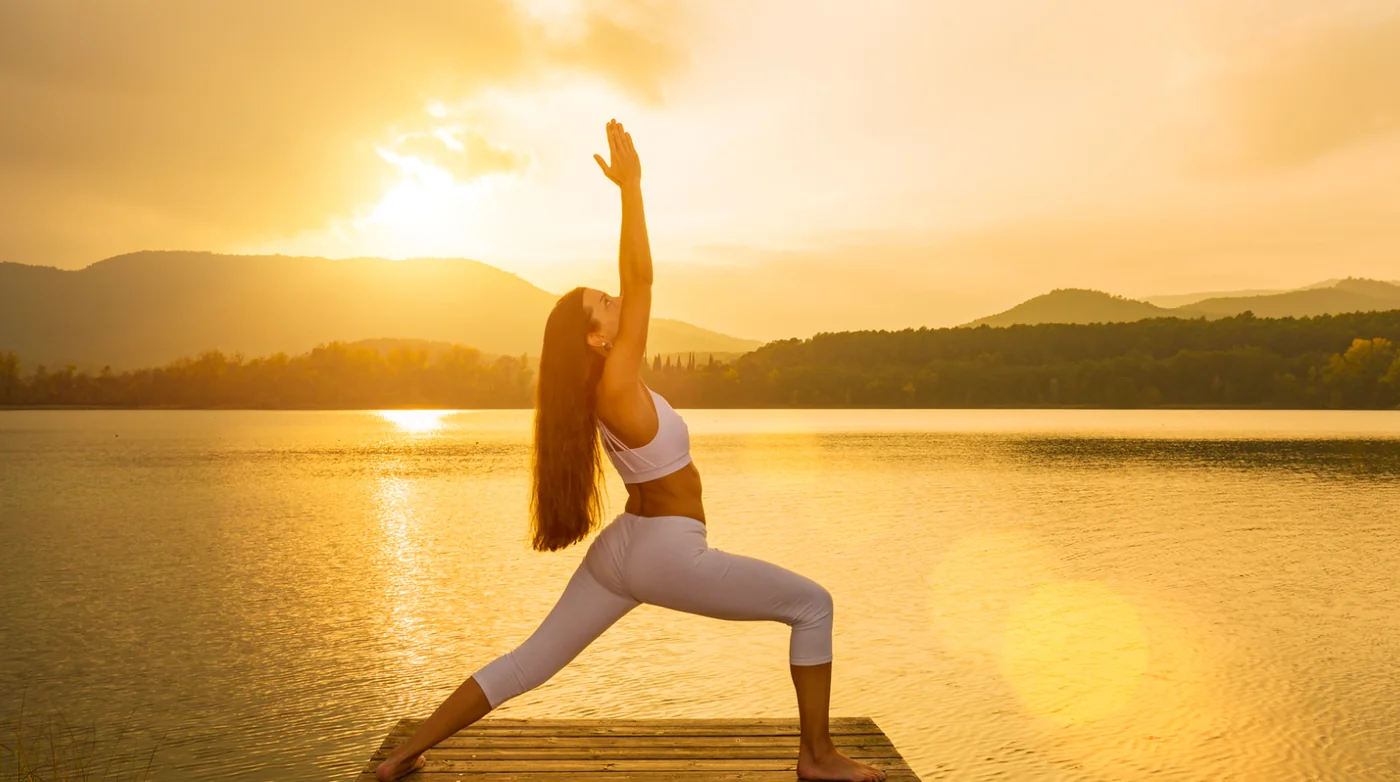
For years, my relationship with movement was transactional. I exercised to burn calories, to manage stress, to be able to wear certain clothes, to check the box that said I’d done a good thing for myself. The movement was a means to outcomes. The actual experience of moving (what my body felt like in motion, what showed up when I paid attention) was almost beside the point.
Then I tried a yoga class taught by someone who insisted, gently but firmly, that we slow down enough to feel what was actually happening. Not the perfect pose. The sensation. The breath. The micro-adjustments your body wanted to make if you let it. I didn’t burn many calories that day. But I left feeling more at home in my body than I had in years.
That’s mindful movement. It’s not a specific practice: yoga, tai chi, qigong, walking meditation, intuitive dance can all qualify, and so can a slow morning stretch on your living room floor. What makes it mindful is the quality of attention you bring. This article is about what that quality of attention is, why it matters, and how to build a movement practice that actually meets you in your body.
In This Article
Key Takeaways
- Mindful movement is movement done with full attention to what’s happening in the body, not just the goal of the movement.
- It works because it integrates the nervous system, the body, and the mind in a way regular exercise often doesn’t.
- Many practices qualify (yoga, tai chi, walking, swimming, dance) when done with the right attention.
- You don’t need a class or a teacher to start. Five mindful minutes at home is a complete practice.
- The benefits compound, better body awareness leads to better self-regulation, better recovery, and a different relationship with effort itself.
What Makes Movement Mindful
The defining feature of mindful movement is attention. Specifically, attention to what your body is actually feeling and doing while it moves, rather than attention pulled forward toward the next thing, backward toward analysis, or sideways toward the mirror.
In mindful movement, you’re tracking sensation. The stretch in the hamstring. The contact between foot and floor. The way the breath rises and falls in the ribs. The micro-adjustments the body wants to make moment to moment. You’re not thinking about the movement; you’re feeling it.
This is different from being lost in thought while moving: which is what most exercise looks like. It’s also different from rigid concentration or grim discipline. The attention is open, curious, gentle. It allows for the body’s input rather than overriding it.
How It Differs From Regular Exercise
Regular exercise tends to be goal-driven. You’re going for a distance, a calorie burn, a certain heart rate, a specific number of reps. The mind sets a target, and the body executes. The movement is, in a real sense, dictated from outside the body.
Mindful movement is goal-aware but body-led. You may know you want to walk for thirty minutes, or do a particular sequence of poses, but the moment-to-moment quality of how you move is informed by what the body is asking for. Some days the body wants more challenge; some days it wants gentleness. The practice listens.
This doesn’t mean mindful movement is easy or unchallenging. A skilled mindful movement practice can be physically demanding. The difference is that the demand emerges from inside the practice, in conversation with the body, rather than imposed regardless of what the body is communicating.
Why It Works So Well
Mindful movement does something most exercise doesn’t: it integrates. It brings the nervous system, the body, and the mind into the same project. That integration is what makes it so disproportionately effective for stress, sleep, mood, and overall wellbeing.
Some of the specific mechanisms researchers have observed:
- Increased body awareness, which improves self-regulation and decision-making about basic needs (hunger, fatigue, pain).
- Activation of the parasympathetic nervous system through breath-coordinated movement, supporting recovery.
- Reduction in rumination, because attention is held in present-moment sensation.
- Improved interoception, the sense of the internal state of the body, which correlates with emotional health.
- Better proprioception and balance, which has functional benefits as we age.
- Reduced injury risk, because you’re listening to your body’s signals.
The practice does what cognitive mindfulness does, plus what exercise does. The combination is more than the sum of its parts.
The Different Forms of Mindful Movement
Many traditions have developed mindful movement practices, often over centuries. Each has its own flavor.
Yoga. The most familiar in Western contexts. Slower styles (yin, restorative, gentle hatha) tend to be more inherently mindful than faster flow styles, but any yoga can be mindful with the right attention.
Tai chi. A Chinese martial arts tradition that has evolved into a slow, flowing movement practice. Excellent for balance, joint health, and nervous system regulation. The pace is naturally meditative.
Qigong. Related to tai chi but often simpler, with shorter sequences. Easy entry point for beginners.
Walking meditation. Slow, deliberate walking with full attention to sensation in the feet, the legs, the breath. Can be done anywhere, even a hallway.
Feldenkrais and Alexander Technique. Body education methods that train mindful, efficient movement patterns.
Somatic practices. A broad category of body-based work (somatic experiencing, body-mind centering, gentle dance) that emphasizes interoception and felt sense.
Intuitive dance. Moving freely to music, following what the body wants. Less structured but powerfully mindful when done with attention.
You don’t need to commit to one tradition. Many practitioners draw from several. The forms are vehicles for the underlying practice, moving with full presence, and you can ride more than one.
How to Begin
You don’t need a class, a teacher, or a mat to start. You need five minutes and a willingness to slow down.
Here’s a simple beginner sequence you can do anywhere:
- Stand still. Feel your feet on the floor. Notice the weight distribution between your feet, the way your spine rises from your pelvis, the way your shoulders rest. Take three slow breaths.
- Slowly raise your arms overhead, breathing in. Slowly lower them, breathing out. Repeat five times. Pay attention to how it feels, the stretch through the sides, the way the breath supports the movement.
- Roll your head gently in a small circle in each direction. Slow. Notice the back of the neck, where it’s tight, where it’s free.
- Bend forward from the hips, letting the head and arms hang. Stay for five breaths. Roll up slowly, vertebra by vertebra.
- Return to standing. Take three more breaths. Notice how you feel now compared to how you started.
That’s a complete mindful movement practice. It takes about five minutes. The point isn’t the specific sequence, feel free to substitute movements your body responds to. The point is the attention you bring.
A Sample Daily Practice
For a more developed daily practice, here’s a structure that works for many people:
Morning (10-20 minutes): A gentle wake-up sequence: some stretching, slow breath, a few minutes of standing meditation or qigong. The point is to arrive in your body before the day takes you.
Midday (5 minutes): A walking meditation, or a few mindful movements at your desk: shoulder rolls, neck stretches, standing up to feel your feet. A reset.
Evening (15-30 minutes): A longer practice (yoga, tai chi, dance, or whatever calls) done with full attention. This often serves as a transition from the doing-mode of the day to the resting-mode of evening.
You don’t have to do all three. One is enough. Pick what fits your life and what your body responds to. The consistency matters more than the duration.
One mistake worth avoiding: don’t tie your practice to a specific outcome metric. Trying to be “more flexible” or “stronger” or “calmer-by-Tuesday” pulls the practice back into goal-mode and out of the present-moment quality that makes it work. The benefits will come, research is clear on that, but they come most reliably when the practice itself is the point. Trust that the body is reorganizing in ways you can’t measure, and let the metrics catch up to the practice rather than the other way around.
When You Don’t Feel Like Moving
There will be days when the practice feels like one more obligation. The body wants to be still. The mind is resistant. This is information, not failure.
On those days, scale way down. Two minutes of standing breath. A few neck rolls in bed before you get up. A slow walk to the mailbox. The practice doesn’t ask for performance. It asks for presence, in whatever form is available.
Sometimes the resistance is the body asking for rest. Listen. A day of skipped practice in service of actual rest is not a failure of discipline, it’s the practice working. Mindful movement teaches you to honor what your body is communicating, including when it’s communicating that it needs less, not more.
Bringing Mindfulness Into Any Movement
One of the gifts of building this skill is that it transfers. Once you know what mindful movement feels like, you can bring elements of it into any movement you do.
The walk to the car becomes an opportunity to feel your feet on the ground. The reach for a mug becomes a chance to notice your shoulder. The bend to pick up a child becomes a moment of body awareness rather than autopilot. The yoga isn’t only on the mat anymore.
This is, in some ways, the deeper point of the practice. It’s not just about the time you spend in formal practice, it’s about how that practice changes the rest of your day. The way you climb stairs. The way you sit at a desk. The way you notice when something hurts before it gets worse. The way you feel the difference between healthy fatigue and the kind that needs rest.
You start to live in your body again, not just on top of it. And from there, almost everything else gets easier: sleep, mood, decision-making, relationships, even how you handle hard feelings. The body is the place all of life actually happens. Mindful movement is the practice of returning, again and again, to the place you’ve been all along.
Sources
- Mind and Body Approaches for Stress and Anxiety: What the Science Says, National Center for Complementary and Integrative Health.
- Mindfulness-Based Interventions for Anxiety and Depression, PubMed Central, Psychiatric Clinics.
- Adult Physical Activity Basics, Centers for Disease Control and Prevention.
- Stress effects on the body, American Psychological Association.
- 8 Things to Know About Meditation and Mindfulness, National Center for Complementary and Integrative Health.
The Free Subscriber’s Library Is Open
Join Peacefully Proven for a growing collection of free wellness tools, guides, and printables, plus a guided forest bathing meditation to begin. All yours, always free.







Join the conversation and add your thoughts.