
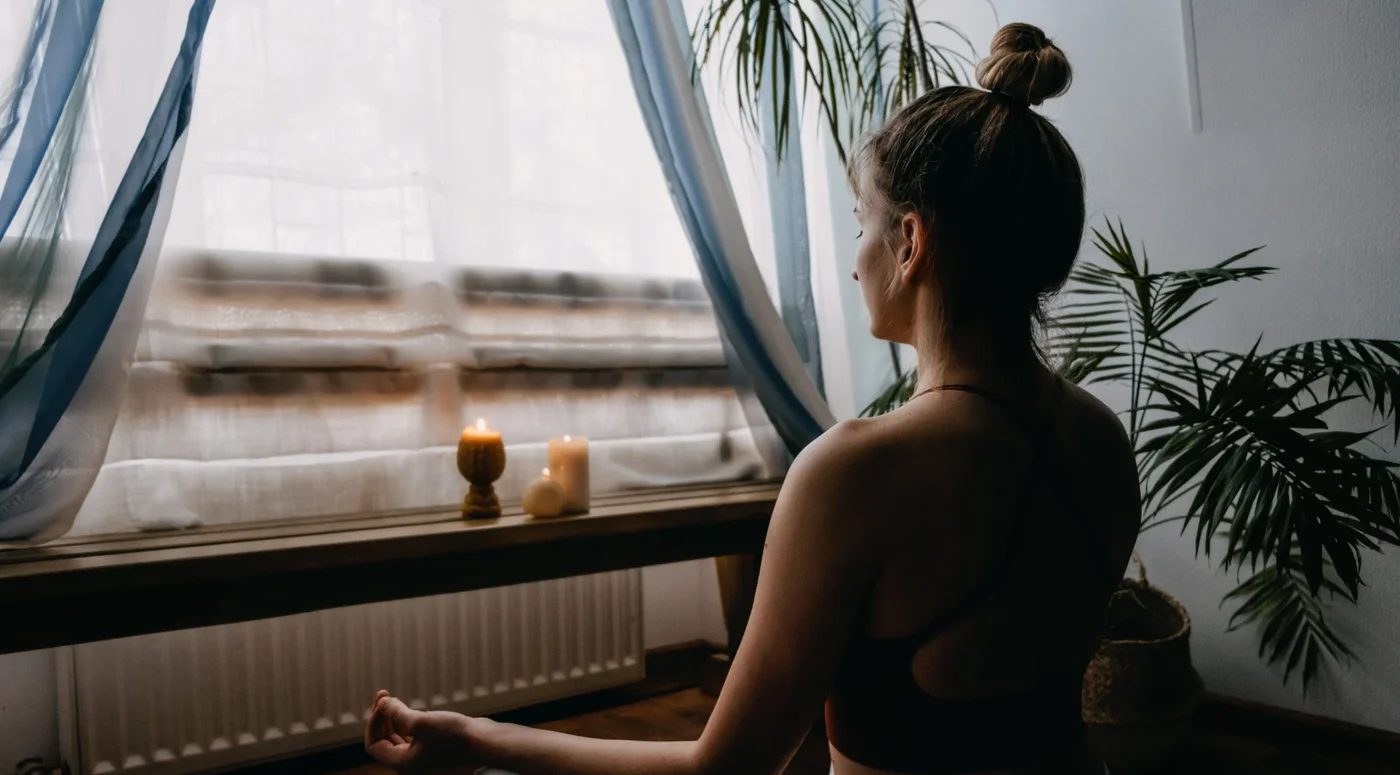
I have been meditating for about thirteen years now. Some days it is a ten-minute practice at bedtime with my legs resting up against the headboard. Some days it is a one-minute breathing break between calls. Some nights it is a Headspace sleep story playing softly while I try to drift off. It has become such a normal part of my life that I rarely stop to think about it.
But lately I have been wondering what I would say to myself on the very first day, if I could sit down beside that beginner for a few minutes. Not a lecture. Just a few kind, honest things that are easier to see after thirteen years than at the start.
This article is that conversation. It is written to my beginner self, and to you, whether you are on your first day, your first month, or picking meditation back up after a long break. I have also included what research says about each lesson, so you can see what the evidence does and does not show.
In This Article
- Your Mind Will Wander, and That Is the Practice
- A Minute Counts More Than You Think
- Using a Guide Is Not Cheating
- Meet Yourself Where You Are, Even Lying Down
- Meditation Will Not Fix Everything, and That Is Okay
- Bring It Into the Rest of Your Day
- Pair It With Other Kind Habits
- Be Patient With the Slow Kind of Change
Key Takeaways
- A wandering mind is normal. Noticing it and coming back is the skill you are building.
- Short practices count. One or two minutes of slow breathing during a busy day is real practice.
- Guided meditations, apps, and sleep stories are a fine way to practice, at any stage.
- Research suggests meditation can help with stress, anxiety, and sleep, but results are mixed and it is not a replacement for medical care.
- The changes tend to be small and gradual. Being patient and kind with yourself is part of the practice.
Your Mind Will Wander, and That Is the Practice
If I could tell my beginner self only one thing, it would be this: your mind is going to wander, over and over, and that does not mean you are bad at meditation. It means you are a person.
Most people sit down for the first time expecting a calm, empty mind. Instead they find a to-do list, a song stuck on repeat, a worry about tomorrow, and a sudden itch on their nose. It is easy to decide that meditation must not be for you. Please do not decide that yet.
Our minds drift all day long, not only when we meditate. A Harvard study used an iPhone app to check in with 2,250 volunteers at random times during their day. As the Harvard Gazette reported, people’s minds were wandering 46.9 percent of their waking hours on average. Meditation does not create that busy mind. It just helps you notice it.
Harvard Health describes a common style called focused attention meditation in Easily distracted? Try meditation. You rest your attention on one thing, such as your breath. When your mind wanders, you notice what pulled you away, let it go, and come back. The article explains that with regular practice you get better at noticing distractions and returning your focus more quickly.
That moment of noticing is the practice. Every time you catch yourself drifting and come back, you are building the skill. A session where your mind wanders thirty times is not a failed session. It gives you thirty chances to practice coming back.
Counting your breaths can help. In a set of four studies with more than 400 participants, researchers including Richard Davidson found that people who were more accurate at counting their breaths showed less mind wandering and better mood. In a four-week training study, people who practiced breath counting had less mind wandering afterward than people in the comparison groups.
Noticing that your mind has wandered is not a mistake in meditation. It is the moment the practice happens.
A Minute Counts More Than You Think
The second thing I would tell my beginner self is that you do not need a long, perfect block of time. Short practices count.
I work from home running my own consulting business, and I am on the computer most of the day, often on calls. My days do not always have room for a long sit. What they do have room for is one or two minutes of deep breathing between tasks. I take those short breaks during the workday. They are short enough to fit between calls, which is exactly why they work for me.
Harvard Health’s guide What meditation can do for your mind, mood, and health suggests starting with 10 minutes, or even five minutes twice a day, ideally at the same time each morning. That is a gentle place to begin. And if five minutes feels like too much today, one minute is still a start.
Here is a simple one-minute practice you can try right now:
- Sit back in your chair and let your feet rest on the floor.
- Take a slow breath in through your nose.
- Let a long, easy breath out.
- Repeat for about a minute, counting each out-breath if it helps.
- Before you go back to work, notice one thing: how your shoulders feel, the sounds around you, or the temperature of the air.
If you would like more short practices like this, our guide to 1-to-5-minute micro-mindfulness practices has plenty of ideas.
Using a Guide Is Not Cheating
Some people feel that “real” meditation means sitting in silence with no help. I would tell my beginner self to let go of that idea. A guide is a tool, and tools are good.
I use the Headspace app. I listen to its sleep stories and music at night, and I love its one-minute animated videos where experts explain an idea in a simple, friendly way. Those short videos are a nice reminder that you can learn something useful about your mind in sixty seconds.
Guided practices help in a few ways. They give your attention somewhere to rest. They remind you to come back when you drift. And they take the guesswork out of what to do next, which can make it easier to start on a day when you do not feel like it.
If you are brand new, I would suggest starting with a short guided practice rather than a long silent one. I shared why in New to Meditation? This Headspace Beginner’s Guide Is Where I Would Start. Headspace is not the only option, of course. Use whatever voice, app, or video helps you show up.
Meet Yourself Where You Are, Even Lying Down
Many beginner guides tell you to sit upright, and there is good reason for that, since it is easier to stay alert. But I would tell my beginner self that it is fine to have more than one kind of practice, and one of them can be at bedtime.
Most nights I do about ten minutes of meditation with my legs up against the headboard. It is part of my sleep routine, along with magnesium, a sleep essential oil blend on my chest, my DIY linen spray, the diffuser, my Himalayan salt lamp, and Headspace sleep stories or music. I wrote about that practice in Legs Up the Headboard: The 10-Minute Bedtime Meditation I Do Every Night, if you would like to try it.
There is some research behind meditation for sleep. Harvard Health described a small study of 49 middle-aged and older adults who had trouble sleeping. Half took a mindfulness program and half took a sleep education class, meeting once a week for six weeks. By the end, the mindfulness group had less insomnia, fatigue, and depression than the sleep education group.
The same article offers a tip I think is helpful for beginners: practice during the day too, sitting up or moving gently, so it becomes easier to call on that relaxation at night. So my advice is both. Keep a bedtime practice if it helps you settle, and also practice when you are awake enough to notice what your mind is doing.
Meditation Will Not Fix Everything, and That Is Okay
This is the lesson I most want to get right, because I think it protects people from disappointment.
Meditation helps me. It is one of the tools I use for my mood, along with my gratitude journal and my breathing breaks. But it has not solved everything. I still wake up at 3 AM some nights, and I still wake up tired every morning. And when menopause brain fog had me counting on my fingers to add single digits, the thing that cleared it was hormone therapy, not meditation.
The research is honest about this too. The National Center for Complementary and Integrative Health, part of the National Institutes of Health, sums up the evidence on its page Meditation and Mindfulness: Effectiveness and Safety. A few highlights, in plain words:
- A 2018 analysis of 142 groups with more than 12,000 participants found mindfulness approaches worked better than no treatment for anxiety and depression.
- A 2019 analysis of 18 studies found mindfulness meditation improved sleep quality more than education-based treatments.
- Results for pain are mixed, and many studies in this field are small or of low quality.
- Meditation is usually considered low-risk, but a 2020 review found about 8 percent of participants had a negative effect, most often anxiety or depression. That is similar to the rate for talk therapies.
NCCIH also advises not using meditation to replace conventional medical care. I agree with that completely. If something feels wrong in your body or your mind, please talk with your doctor. And if meditation ever stirs up feelings that are too heavy, it is okay to stop, open your eyes, and reach out to someone you trust or to a professional.
Meditation can be one helpful tool among many. It does not have to be the answer to everything to be worth doing.
Bring It Into the Rest of Your Day
It is easy to think of meditation as something that happens only during a formal sitting. I would tell my beginner self that the most useful part is what happens afterward.
Harvard Health notes that the skill you build in focused attention meditation, noticing a distraction, letting it go, and returning, can make it easier to switch between tasks. A day full of calls and screens pulls attention in a dozen directions. A short pause to breathe can help you notice where your attention has gone and bring it back to what is in front of you.
Here are a few gentle ways to bring your practice into ordinary moments:
- Before a call or meeting, take three slow breaths and notice your feet on the floor.
- When you notice you are rushing, slow down one small action, such as pouring a glass of water, and give it your full attention.
- When an email or message stirs up frustration, pause for one breath before you reply.
- At the end of the workday, take a minute to notice how your body feels before you move on to the evening.
If breathing practices appeal to you, you might enjoy five breathwork techniques for stress relief.
Pair It With Other Kind Habits
Another thing I would tell my beginner self: meditation works best alongside other kind habits, not all by itself.
Meditation is one part of how I care for my mood. The others are my gratitude journal, my breathing breaks, snuggling my dogs and cats, quiet time alone, and saying no when I need to protect my wellbeing. I have also practiced yoga for about seventeen years.
No single habit has to do all the work. Together, they support your wellbeing from different sides. If meditation is hard for you right now, a gentler place to start might be a walk, a few slow stretches, a page in a journal, or a few quiet minutes with a pet. Those count as caring for your mind too.
Be Patient With the Slow Kind of Change
The last thing I would tell my beginner self is to be patient. The changes from meditation are usually not dramatic. They are small and they add up.
Harvard Health’s guide says you may start to notice changes in your mood and stress within a week or two of regular practice. That is encouraging. But the deeper changes, such as catching yourself sooner when you are upset or being a little kinder to yourself on a hard day, tend to build slowly over months and years.
You are also not alone. NCCIH reports that the share of U.S. adults who practiced meditation more than doubled between 2002 and 2022, from 7.5 percent to 17.3 percent. Many people are learning this skill alongside you, and most of them are working with busy minds too.
So here is my letter to my day-one self, and to you, in a few short lines:
- Your mind will wander. Come back, gently, as many times as it takes.
- One minute counts. Start small and let it grow.
- Use a guide if it helps. There is no prize for doing it the hard way.
- It is okay to meditate lying down at night and sitting up during the day.
- Meditation is one tool, not a cure for everything. Talk to your doctor about what it cannot fix.
- Bring it into your day, a breath at a time.
- Be patient, and be kind to yourself along the way.
Thirteen years in, I am still practicing, still wandering, and still coming back. I think that is exactly how it is supposed to work.
Sources
- Meditation and Mindfulness: Effectiveness and Safety, National Center for Complementary and Integrative Health.
- What meditation can do for your mind, mood, and health, Harvard Health Publishing.
- Easily distracted? Try meditation, Harvard Health Publishing.
- Mindfulness meditation helps fight insomnia, improves sleep, Harvard Health Publishing.
- Wandering mind not a happy mind, Harvard Gazette.
- A mind you can count on: validating breath counting as a behavioral measure of mindfulness, Frontiers in Psychology.
Free 10-Minute Forest Bathing Meditation
Subscribe to Peacefully Proven and receive a free guided meditation to restore calm and clarity, delivered straight to your inbox.







Join the conversation and add your thoughts.