
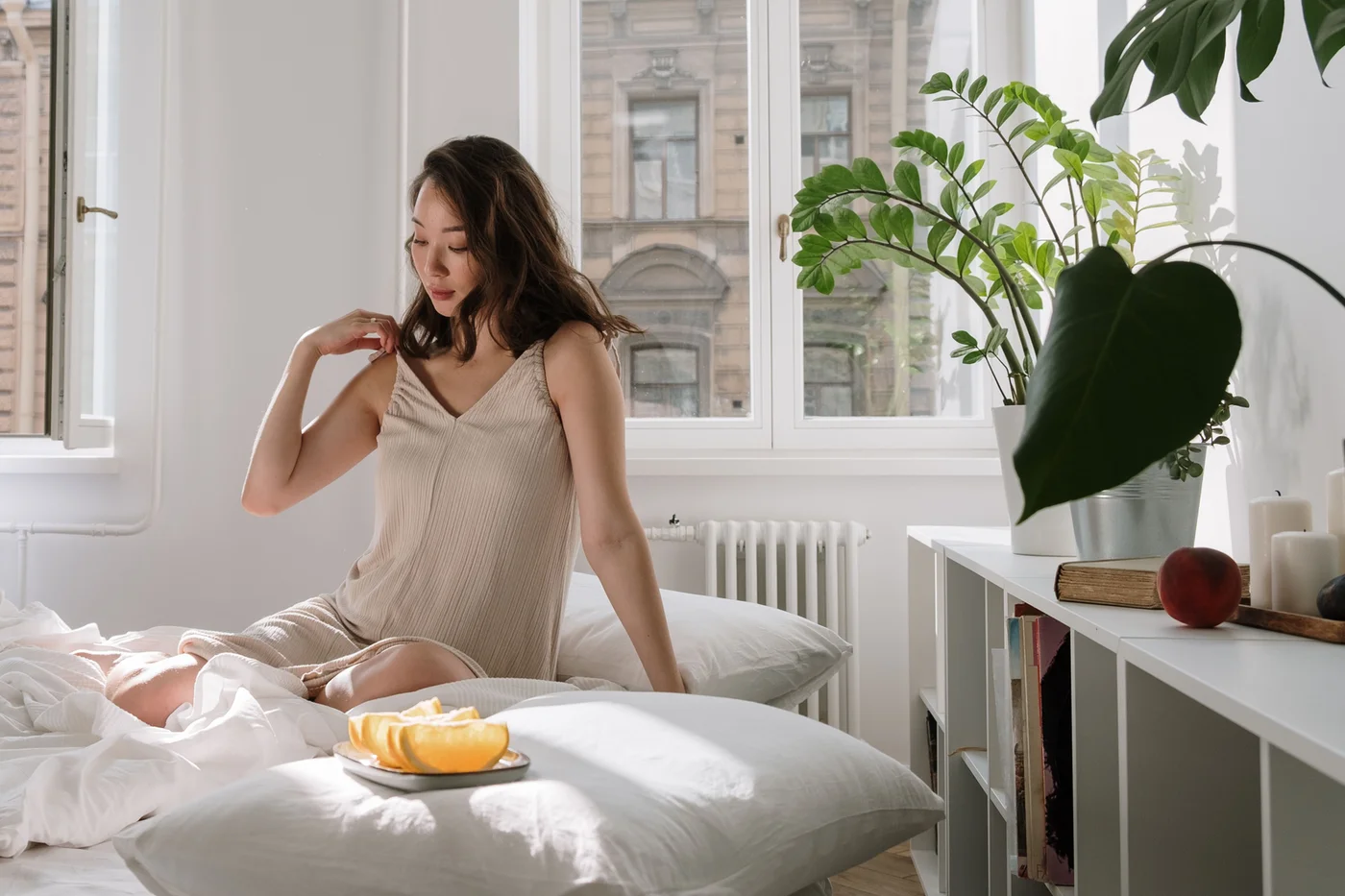
One part of my bedtime routine is so simple it barely sounds like a practice. I lie back in bed, swing my legs up so they rest against the headboard, and meditate for about ten minutes. That is it. No special equipment, no getting down on the floor, and no pressure to do it perfectly.
I have practiced yoga for about seventeen years and meditation for about thirteen, so this little practice brings together two things I love. It is my version of a well-known restorative yoga pose called legs up the wall, or viparita karani. I simply use the headboard instead of the wall.
I want to be honest from the start: this is not a cure for my sleep problems. I am in menopause, and insomnia and 3 AM wake-ups are still part of my life. I wake up tired every day. But these ten minutes are a calm way to move from the busy day toward rest, and I wanted to share how you can try a legs up the wall meditation for sleep, what research does and does not say about it, and who should check with a doctor first.
In This Article
Key Takeaways
- Legs up the wall (viparita karani) is a gentle, restorative yoga pose. You can do it in bed with your legs resting against the headboard.
- A Cleveland Clinic physician says many patients find the pose very calming, but there is no evidence it treats headaches or high blood pressure.
- Research suggests yoga may help sleep quality, while the evidence on mindfulness for insomnia is mixed.
- People with glaucoma should avoid this pose, and people with heart, kidney, or liver failure or uncontrolled high blood pressure should talk to a doctor first.
- Start with a few minutes, come out slowly, and let the meditation be simple.
Where This Fits in My Bedtime Routine
Menopause has made sleep harder for me. Hot flashes that felt like burning from the inside out and drenching night sweats were a big part of that. HRT has mostly resolved those, which I am so grateful for. The insomnia and 3 AM wake-ups are still with me, though, so I lean on a routine that helps my body and mind wind down.
Here is what my routine includes:
- Magnesium.
- A sleep essential oil blend on my chest.
- My DIY linen spray made with marjoram, lavender, cedarwood, and ylang ylang.
- A diffuser.
- My Apollo Neuro device.
- Headspace sleep stories or sleep music.
- A Himalayan salt lamp.
- About ten minutes of meditation with my legs up against the headboard.
No single item on that list is magic. Together, they tell my body that the day is over. If you would like to see a full bedtime routine laid out step by step, our post on my bedtime routine during menopause goes into more detail.
You do not need a perfect sleep routine. You need a few small things that help you feel safe, calm, and ready to rest, done often enough that your body starts to recognize them.
What Is Legs Up the Wall (Viparita Karani)?
Legs up the wall is a restorative yoga pose. You lie on your back with your head and torso flat and your legs resting straight up against a wall. According to Cleveland Clinic, the Sanskrit name viparita karani comes from viparita, meaning “inverted,” and karani, meaning “in action.”
It is called an inversion because your legs are higher than your heart. But unlike a headstand or shoulder stand, it puts no weight on your head or neck. That is part of why it is so popular as a gentle pose for beginners, for the end of a yoga class, and for winding down at night.
Restorative poses like this one are meant to be held for a while with as little effort as possible. The goal is not stretching or strength. It is rest. If you enjoy this style of yoga, our guide to restorative yoga poses for long desk days has more ideas.
What We Know, and What We Do Not
I think it is important to be clear about the evidence, because you will find a lot of big promises about this pose online.
What a doctor says about the pose itself
In the Cleveland Clinic article, Dr. Robert Saper, a physician who leads wellness and preventive medicine there, explains that the pose can help move fluid that has pooled in the legs back into circulation, which may ease swelling in the lower legs. He also says many of his patients find the pose very calming, and that lowering stress is linked with better physical and mental health.
He is just as clear about the limits. Some people claim the pose treats headaches or high blood pressure. On those claims, he says “there’s no evidence of that.”
What research says about yoga and sleep
Research has not looked at legs up the headboard before bed specifically, so it helps to look at the bigger picture. The National Center for Complementary and Integrative Health (NCCIH) has a helpful summary on sleep disorders and complementary health approaches. It describes a 2020 review of 19 studies with 1,832 participants, which suggested that yoga may improve sleep quality in women with sleep problems, but not necessarily insomnia. Its page on yoga’s effectiveness and safety adds that smaller studies of women with menopause symptoms also reported improved sleep.
What research says about meditation and sleep
The evidence on meditation is more mixed. In one small study described by Harvard Health, 49 middle-aged and older adults with trouble sleeping took either a mindfulness program or a sleep education class, meeting once a week for six weeks. At the end, the mindfulness group reported less insomnia, fatigue, and depression.
On the other hand, NCCIH notes that guidelines have not found enough evidence to recommend mindfulness meditation on its own as a treatment for insomnia, and a 2022 review of 20 studies with 2,890 participants found that mindfulness-based stress reduction might not improve sleep quality in people with insomnia. The authors noted that the studies were small and had problems with bias.
So what does that mean for you?
Here is how I put it together. This pose and this meditation are gentle ways to relax at bedtime. Relaxing before bed is worth doing for its own sake. But they are not proven treatments for insomnia, and they did not cure mine. If you have ongoing sleep problems, please talk with your doctor. For me, HRT made the biggest difference for my menopause symptoms, and a good doctor can help you look at what is going on for you.
Why the Headboard Instead of the Wall
The classic version of this pose is done on a mat on the floor, with your hips close to a wall. That works well during the day. At bedtime, the headboard version has a few advantages:
- You are already in bed. When you finish, you simply bring your legs down, turn around, and settle in to sleep. No getting up off the floor.
- The mattress is soft. It cushions your back, hips, and head, which can feel kinder on achy joints.
- It fits the mood. The lights are low, the room is ready for sleep, and you stay in that calm space.
There are a couple of things to keep in mind. Your headboard needs to be sturdy enough to rest your legs against, and some headboards are not flat or tall enough. If yours does not work, a clear wall next to your bed can work the same way. And a very soft mattress may let your hips sink more than the floor would, so a folded blanket under your hips can help you feel more supported.
How to Try It, Step by Step
These steps are adapted from the Cleveland Clinic instructions for the classic pose, with notes for doing it in bed.
- Set up your space. Turn down the lights. If you like, have a thin pillow nearby for your head and a folded blanket for your hips.
- Sit sideways near the headboard. Sit with one hip close to the headboard and your knees bent.
- Swing your legs up. Lower your back down onto the bed as you swing your legs up so the backs of your legs rest against the headboard. Your head and back should be flat on the bed.
- Adjust your distance. Scoot your hips a few inches away from the headboard so your legs are relaxed. Keep your knees soft. You should feel a light stretch at most, never pain. If the backs of your legs feel tight, move your hips farther away.
- Let your arms rest. Rest your arms by your sides with your palms up, or place your hands on your belly.
- Breathe and stay. Cleveland Clinic suggests holding the pose for two to three minutes, or longer if you like. I stay for about ten minutes, but there is no need to start there. Begin with a few minutes and see how you feel.
- Come out slowly. Bend your knees, roll gently onto one side, and rest there for a moment. Cleveland Clinic recommends moving into a seated position and sitting still for at least 30 seconds before getting up. At bedtime, you may simply want to settle in to sleep.
If your legs start to tingle or feel numb, bend your knees, let your feet slide down the headboard a bit, or come out of the pose. Comfort matters more than how long you stay.
A Simple 10-Minute Meditation for the Pose
Once you are settled, you can use any meditation you like. Below is a simple practice you can follow on your own. You can also use a guided meditation from an app. My bedtime routine includes Headspace sleep stories and sleep music, and you can read more in our body scan for sleep article if you would like a guided option.
Harvard Health’s tips for evoking the relaxation response (a term coined by Dr. Herbert Benson for the body’s shift away from the stress response) can be summed up in two steps: choose a calming focus, and let go when your mind wanders. This practice is built on those two steps.
Minutes 1 to 2: Arrive
Close your eyes. Notice the weight of your body on the mattress and the feeling of your legs resting against the headboard. Let your shoulders drop. Let your jaw soften.
Minutes 2 to 5: Follow the breath
Choose your breath as your calming focus. Notice the air coming in and going out. You do not need to change it. If it helps, say “in” to yourself as you breathe in and “out” as you breathe out. When your mind wanders, and it will, notice where it went, and gently come back to the breath. No scolding. Coming back is the practice.
Minutes 5 to 8: Soften the body
Slowly move your attention from your feet down your legs, into your hips, belly, chest, arms, neck, and face. As you notice each area, invite it to soften on the out-breath. If you find a spot that feels tight or sore, just notice it with kindness. You do not need to fix anything.
Minutes 8 to 10: Let go
Let go of any focus. Just rest. If thoughts come, let them come and go. Before you come out of the pose, take one slower, deeper breath. Then bend your knees and roll gently to one side.
If you fall asleep in the pose, that is okay, though you may wake up with tingly legs. A timer with a soft sound can help if you want to come out after a set time.
Who Should Check With a Doctor First
Legs up the wall is one of the gentlest poses in yoga, but it is still an inversion, and it is not right for everyone.
Glaucoma
This is the most important one. In the Cleveland Clinic article, Dr. Saper says people with glaucoma should not do this pose at all. A small study in PLOS ONE, Intraocular Pressure Rise in Subjects with and without Glaucoma during Four Common Yoga Positions, measured eye pressure in 20 people (10 with glaucoma and 10 without) while they held four head-down yoga poses for two minutes each. Legs up the wall was one of them. Eye pressure rose in all four poses within one minute, in people with and without glaucoma. Legs up the wall had the smallest rise of the four, and pressure tended to return to baseline within about two minutes of sitting up. The researchers said they could not rule out harm for people with glaucoma. If you have glaucoma or are at risk for it, please ask your eye doctor before trying any head-down pose.
Heart, kidney, or liver conditions and blood pressure
Cleveland Clinic says people with congestive heart failure, kidney failure, or liver failure (cirrhosis) should avoid this pose, or do it only rarely and with their doctor’s guidance, because moving fluid from the legs back toward the heart could add strain. People with uncontrolled high blood pressure should wait until a doctor has their blood pressure under control.
Pregnancy
NCCIH advises people who are pregnant to avoid long periods of lying on their back and to ask their health care provider how to adjust their activity.
Back, hip, and knee concerns
NCCIH lists lumbar spine disease and earlier knee or hip injuries among the conditions that may call for modifying yoga poses. If you are recovering from surgery or an injury, check with your doctor or physical therapist before adding a new pose.
A note for older adults
NCCIH notes that emergency room visits for yoga-related injuries are more common in people 65 and older. Move slowly, use pillows and blankets for support, and skip anything that hurts.
Gentle does not mean right for every body. A quick question to your doctor or eye doctor is a small step that helps you practice with peace of mind.
Tips for Making It a Nightly Habit
- Keep it short at first. Two or three minutes is a fine start. You can build up to ten if it feels good.
- Pair it with something you already do. Linking a new habit to an existing part of your routine, such as turning on a salt lamp or a diffuser, can make it easier to remember.
- Keep your props nearby. A thin pillow and a folded blanket by the bed make it easy to get comfortable without getting up.
- Keep your phone out of reach. If you use an app for a guided meditation, start it before you lie back and then set the phone down.
- Be kind to yourself on restless nights. Some nights your mind will race the whole time. That is still practice. It still counts.
- Notice how you feel over time. Instead of expecting one session to change your sleep, notice how you feel over a few weeks.
- Talk to your doctor about sleep problems that will not go away. Insomnia during menopause deserves attention, and you do not have to just live with it. If your doctor will not talk with you about menopause and your symptoms, it is okay to find another doctor.
Ten minutes with my legs up the headboard will not fix everything, and I would never tell you it will. But it gives me a calm, steady way to close the day. I hope you give it a try, in whatever way feels comfortable for your body, and I hope it brings you a little more rest.
Sources
- The Yoga Pose You Need: The Health Benefits of Legs Up the Wall, Cleveland Clinic.
- Intraocular Pressure Rise in Subjects with and without Glaucoma during Four Common Yoga Positions, PLOS ONE (Jasien and colleagues, 2015).
- Sleep Disorders and Complementary Health Approaches, National Center for Complementary and Integrative Health.
- Yoga: Effectiveness and Safety, National Center for Complementary and Integrative Health.
- Mindfulness meditation helps fight insomnia, improves sleep, Harvard Health Publishing.
Free 10-Minute Forest Bathing Meditation
Subscribe to Peacefully Proven and receive a free guided meditation to restore calm and clarity, delivered straight to your inbox.
You Might Also Enjoy
- Why Your Sleep Falls Apart in Perimenopause (and the Full Routine That Has Helped Me)
- Apollo Neuro Review: How I Biohacked My Way to Less Stress
- Magnesium for Sleep: Which Type Is Best and How to Use It
- Early Dark Evenings? Mindful.org’s Guide to Mindfulness for Sleep Is Worth Your Time
- Thirteen Years of Meditation: What I Would Tell Myself on Day One







Join the conversation and add your thoughts.