
I have been eating organic food for about nine years, vegan for about four, and treating food as medicine for about eight. Over that time I have learned something every organic shopper finds out fast: organic food usually costs more at the register. If you have ever stood in the produce section doing math in your head, you are not alone.
You do not need to buy everything organic to eat well. But if organic food matters to you, a few simple habits can make it much easier to afford. None of them are clever tricks. I shop where the organic variety is best, I watch for good sales, I stock up when the price is right, and then I make sure I use every bit of what I bring home. That last part matters more than most people think, because the food we throw away is food we already paid for.
Here is how I shop, how I stock up without wasting anything, and how I turn sale produce into smoothie freezer packs that become an easy snack or even a full meal.
In This Article
Key Takeaways
- Organic food often costs more, so where and when you buy it makes a big difference.
- I find Whole Foods Market and Vitacost have the best organic variety, and I stock up when Vitacost has a good sale.
- The EPA estimates that wasted food costs each American consumer $728 a year, based on 2023 food prices.
- Sale produce can be cut up, frozen on a tray, and packed into smoothie freezer packs for later.
- Adding plant-based protein powder plus flaxseed or almond butter can turn a smoothie into a filling meal.
- A sale only saves money if you eat what you buy. Using every bit is part of the budget.
Where I Shop for Organic Food
I find that Whole Foods Market and Vitacost have the best variety of organic food. Variety matters when you are trying to eat organic, because it means more choices and a better chance of finding what you need.
To keep my costs down, I watch for sales on Vitacost. It has the best sales, and when there is a good one, I stock up.
If you have not shopped online for organic groceries before, I wrote about two trusted online stores for organic living, including Vitacost. Sale prices and discounts change all the time, so the best approach is simple: know what you use most, keep an eye on it, and buy more when it drops.
A few things help when you shop sales:
- Know your regular price. When you know what you usually pay for the items you buy most, you can spot a good sale right away.
- Stock up on what you already use. A sale on something new to you is a gamble. A sale on something you buy every week is a sure thing.
- Think about storage before you click “buy.” Pantry items can wait on a shelf. Fresh produce cannot, so you need a plan for it before it arrives.
Wasted Food Raises Your Grocery Bill
Here is the part of budgeting that often gets left out. We spend a lot of energy finding a lower price, and then some of that food goes bad in the back of the refrigerator. When that happens, we paid for food we never ate.
The U.S. Environmental Protection Agency looked at this in a report published in April 2025. Using USDA food waste data from 2019 to 2023 and grocery price data from 2023, the EPA found “the cost of food waste to each U.S. consumer to be $728 per year.” For a household of four, that comes to $2,913 a year, or about $56 a week.
The report also estimates that each person wastes about 256 pounds of food a year, counting food bought at grocery stores and at restaurants. The EPA says this wasted food adds up to about 11 percent of what an American consumer spends on food.
The EPA estimates that wasted food costs each American consumer $728 a year, based on 2023 food prices. Eating what you buy is one of the simplest ways to lower your grocery bill.
Fruits and vegetables are a big part of that waste. According to the full EPA report, each person wastes about 31 pounds of fresh vegetables a year, worth $59.49, and about 22.6 pounds of fresh fruit, worth $44.58, based on 2023 prices. Those estimates are for all food, not just organic. Since organic produce often costs more, wasting it can mean losing even more money.
This is why I care so much about using every bit. Waste is not only a matter of feeling bad about throwing food away. It is a line on your grocery bill.
Stocking Up on Sale Without Wasting It
Stocking up is a great way to save, but only if the food gets eaten. The EPA’s guide to preventing wasted food at home makes this point clearly: buying in bulk only saves money if you use all the food before it spoils.
So before you stock up, ask yourself a few questions:
- Do I have room for it? Look in your refrigerator, freezer, and pantry before you shop. The EPA suggests this step so you do not buy food you already have.
- Will it keep? Dry goods, frozen foods, and canned goods can wait. Fresh produce needs a plan within a few days.
- What is my plan for the extra? If you cannot eat it fresh in time, decide now how you will save it. The EPA lists freezing as one way to handle surplus fruits and vegetables.
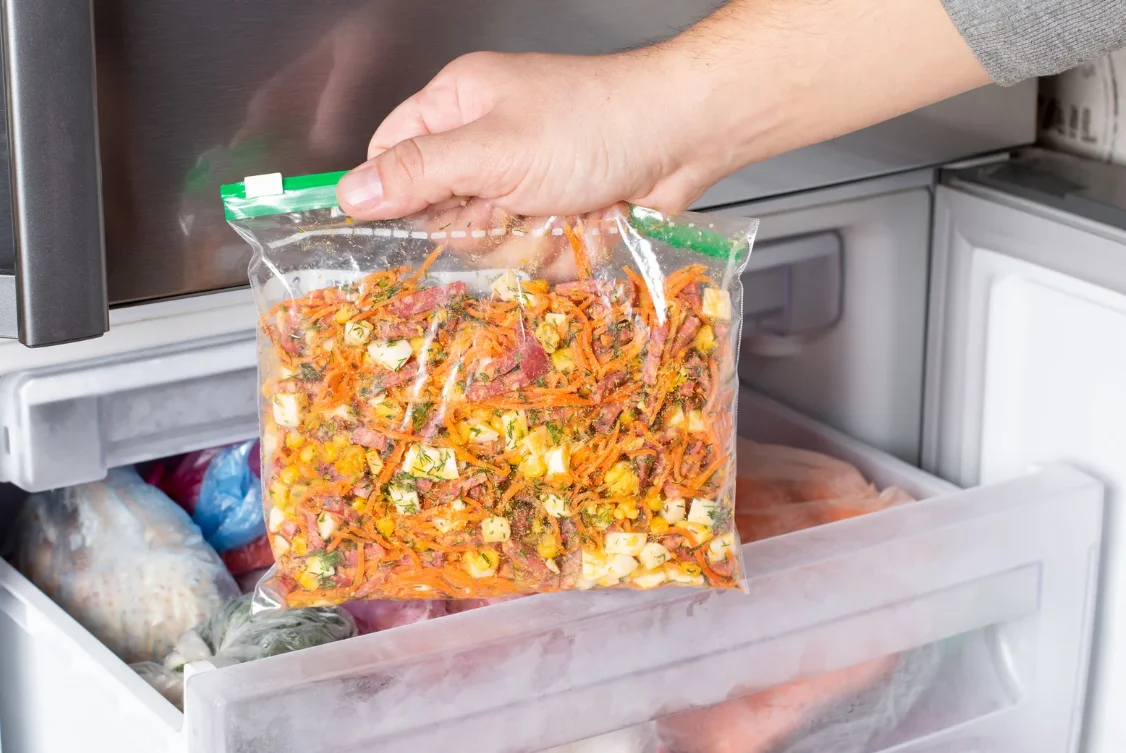
My plan for extra fruits and vegetables is the freezer. When I stock up on produce during a sale, I cut it up and make smoothie freezer packs. That way, nothing is forgotten in a drawer, and I have something easy and healthy ready to pull out later.
Shopping sales also works best when you keep your list focused. Stock up on staples you use again and again, and buy only what you need of everything else. A full cart is not the goal. Eating everything in it is.
How to Make Smoothie Freezer Packs
A smoothie freezer pack is a bag or container of cut-up fruits and vegetables, measured out for one smoothie. When you want one, you pull out a pack, put it in the blender with some water, and blend. It takes almost no time, and it turns a big sale purchase into many easy snacks.
Here is a simple way to make them, using guidance from the National Center for Home Food Preservation, a USDA-supported resource at the University of Georgia.
1. Wash, peel, and cut the produce
Prepare the fruits and vegetables the way you would before eating them. Peel anything with a peel you would not blend, such as bananas. Cut everything into small, even pieces so your blender can handle them easily.
2. Freeze the pieces on a tray first
The National Center describes a method called the tray pack. You spread a single layer of prepared fruit on shallow trays and freeze it. Once frozen, the pieces stay loose instead of freezing into one solid block. That makes it easy to mix fruits together and measure out each pack. The Center notes that you should package the fruit as soon as it is frozen to prevent freezer burn.
3. Pack each smoothie’s worth together
Once the pieces are frozen, divide them into single-smoothie portions. A good mix might be a few handfuls of fruit plus a smaller amount of vegetables. The National Center’s guidance on packaging and labeling foods says to pack food tightly with as little air as possible in the package.
4. Label every pack
The same guidance suggests labeling each package with the name of the food, any added ingredients, and the date you packed it. A quick label helps you use the oldest packs first, which is one more way to keep food from being forgotten.
5. Store at 0°F and use them in time
According to the National Center’s chart on how long you can store frozen foods, fruits and vegetables keep for about 8 to 12 months at 0°F or lower. The Center says food stored longer than that should still be safe, just lower in quality. Smoothie packs are meant to be used, though, so it helps to keep them in your regular rotation instead of saving them for months.
A note on vegetables and greens
Vegetables need one extra step. The National Center recommends blanching vegetables (a short dip in boiling water, then a quick cool-down) before freezing. Blanching stops enzyme actions that can cause loss of flavor, color, and texture, and it helps slow the loss of vitamins. The Center also warns that underblanching is worse than not blanching at all, so follow its times for each vegetable. If you add vegetables to your packs and plan to keep them for a while, blanching will help them stay at their best.
If you would like some recipe ideas to start with, my post on smoothie freezer prep has five healing smoothie combinations you can pack ahead.
Smoothie pack basics: cut it up, freeze it on a tray, pack it with as little air as possible, label it with the date, and keep your freezer at 0°F or lower.
Turning a Smoothie Pack Into a Meal
On its own, a smoothie pack blended with some water makes an easy, healthy snack. I work from home and spend most of the day at the computer, often on calls, so anything quick and healthy is welcome.
With a couple of additions, a smoothie pack can also become a hearty meal replacement. Here is what to add:
- A scoop of protein powder. Choose a plant-based protein powder so the smoothie stays vegan. Many protein powders are made with whey, which comes from milk, so check the label.
- Something rich and satisfying. Flaxseed or almond butter makes the smoothie richer and more filling.
That simple formula (frozen fruits and vegetables, water, protein, and a healthy fat) gives you a balanced meal that takes about as long to make as it takes your blender to run. It also means the produce you bought on sale becomes a meal you would otherwise have had to plan, shop for, and cook.
A few tips for blending from frozen:
- Start with less water. You can always add more. Too much water makes a thin smoothie.
- Let the pack rest for a few minutes. If your blender struggles with frozen pieces, give them a few minutes on the counter first.
- Add the protein powder after the liquid. This helps keep it from sticking to the bottom of the blender.
Using Every Bit
I make sure I use every bit of the food I buy and do not let anything go to waste. This is where the budget pays off. Every piece of fruit or vegetable you eat is one you do not have to buy again.
The EPA’s guide to preventing wasted food at home offers several ideas that fit well with this way of eating:
- Use past-prime produce. Fruits and vegetables that are a little soft or wrinkled are often still fine to eat. The EPA suggests using them in soups, stir-fries, sauces, baked goods, or smoothies. A slightly soft banana or a few tired berries are perfect for a smoothie pack.
- Eat the parts you might usually toss. The EPA encourages using edible parts of food you normally do not eat, if they are safe and healthy. It gives vegetable scraps for soup stock as one example.
- Freeze before it is too late. If you can see that something will not get eaten in time, freeze it now. The EPA lists sliced fruit and leftovers among the foods you can freeze.
- Shop your kitchen first. Look at what you already have before you make a list. This keeps you from buying a second bunch of something while the first one spoils.
For more everyday ideas, take a look at these zero-waste kitchen swaps for a vegan household.
Using every bit takes a little attention at first. After a while, it becomes a habit. You start to notice what is in your refrigerator, what needs to be used soon, and what can go into the freezer. That awareness is the real money saver.
Buying Fewer Prepared Foods
Another way I keep my organic budget in check is by buying fewer prepared foods. Instead of paying for something that is already cut, cooked, or packaged into a ready meal, you can buy the ingredients and prepare them yourself.
There are a few reasons this helps:
- You pay for food, not for preparation. Prepared foods include the work of washing, cutting, and cooking in their price. When you do that work yourself, the money stays with you.
- You know what is in it. When you start with whole ingredients, you choose every one of them. That matters if you eat vegan, eat organic, or are trying to eat less added sugar and salt.
- Whole ingredients are flexible. A bag of organic carrots can become a snack, part of a soup, or part of a smoothie pack. A prepared dish can only be what it is.
Buying fewer prepared foods does not mean you have to cook elaborate meals every night. A smoothie made from a freezer pack is about as simple as food gets, and it is made from whole fruits and vegetables. A few minutes of chopping can save you money and give you more control over what you eat.
Choosing Where Your Organic Dollars Go
If buying everything organic is not in your budget right now, that is completely okay. You can still make choices that matter.
Harvard Health Publishing, in its article Are organics worth it?, notes that organic foods come at a higher price. It suggests that if you want to focus your organic spending, you can avoid the types of fresh produce most likely to keep pesticide residue when grown conventionally. It points to the Environmental Working Group’s Dirty Dozen list, which names the fruits and vegetables with the highest residue levels, and its Clean Fifteen list, which names those with the lowest.
The same article makes another point I appreciate: the most important step toward a healthier diet is simply eating more fruits and vegetables. Organic or not, more produce on your plate is a win.
If you are new to organic living and would like a gentle place to start, my beginner’s guide to peaceful organic swaps walks through small changes you can make one at a time.
Buying organic on a budget comes down to a few simple habits. Shop where the variety is good. Watch for sales and stock up on what you use. Freeze what you cannot eat fresh. Buy fewer prepared foods. And use every bit. Each habit on its own saves a little. Together, they make organic food much easier to afford, and they mean the food you paid for ends up nourishing you instead of filling a trash can.
Sources
- Estimating the Cost of Food Waste to American Consumers, U.S. Environmental Protection Agency, April 2025 (full report, PDF).
- Preventing Wasted Food At Home, U.S. Environmental Protection Agency.
- Dry or Tray Packing for Fruits, National Center for Home Food Preservation.
- Packaging and Labeling Foods, National Center for Home Food Preservation.
- How Long Can I Store Frozen Foods, National Center for Home Food Preservation.
- Blanching Vegetables, National Center for Home Food Preservation.
- Are organics worth it?, Harvard Health Publishing, January 2020.
Free 10-Minute Forest Bathing Meditation
Subscribe to Peacefully Proven and receive a free guided meditation to restore calm and clarity, delivered straight to your inbox.






Join the conversation and add your thoughts.