
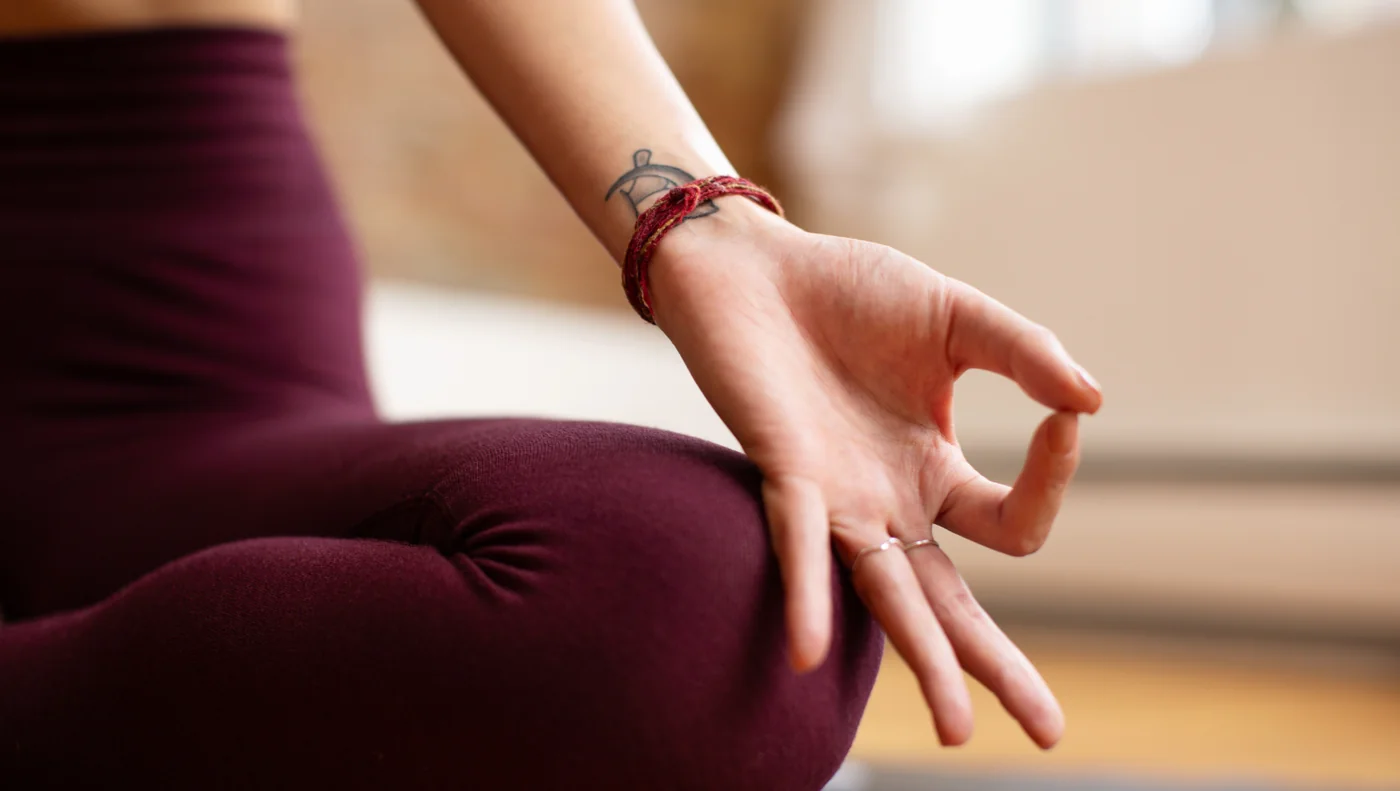
For most of my life, I thought anxiety was something that happened in my mind. My therapist would ask what I was feeling and I’d produce a thought, “I’m worried about the meeting” or “I’m anxious about a friend going through a hard time.” The thoughts were true. But they weren’t the whole story. Underneath each thought was a body in some kind of low-grade alarm, and the body had been like that for so long I’d stopped noticing.
The first time someone helped me actually feel what was happening in my chest, my shoulders, my belly, not think about it but feel it, I cried. Not from sadness. From the relief of finally meeting the part of me that had been carrying the anxiety all along. The body had been waiting to be heard.
This article is about that meeting. About anxiety as something that lives in the nervous system, not only in the mind, and about the simple, accessible somatic practices that can ease it from the bottom up. None of these replace professional support if you need it. All of them can be added to whatever else you’re already doing.
In This Article
Key Takeaways
- Anxiety has a strong body component, not just a mental one.
- Somatic practices work because they speak to the nervous system in its own language.
- Small, repeated practices regulate more reliably than occasional large interventions.
- Self-touch, slow breath, and gentle movement are some of the most direct levers.
- Severe or persistent anxiety deserves professional support, somatic and otherwise.
Why Anxiety Is a Body Story
The traditional model treats anxiety as primarily a thinking problem, irrational thoughts producing irrational feelings. That’s part of the picture, but it’s not the whole picture. Modern trauma research and polyvagal theory have shifted the understanding considerably. Anxiety is also, and often primarily, a state of the autonomic nervous system. The body has registered something as threatening and gone into alarm. The thoughts that come along are often the body’s interpretation of an already-activated state, not the cause of it.
This is why pure cognitive approaches sometimes feel like they’re working on the wrong end of the problem. You can argue with anxious thoughts all day, and the body that’s producing them stays in alarm. Calm the body, and the thoughts often quiet on their own.
The good news is that the autonomic nervous system, while not directly under conscious control, is highly responsive to specific physical signals. Slow exhales, certain kinds of touch, gentle movement, orientation to the environment, all of these speak directly to the part of the system that decides whether to stay in alarm or settle. Somatic practices are essentially conversations with the nervous system in its own language.
Learning to Listen to the Body
Before you try to change what’s happening in the body, it helps to actually feel what’s happening in the body. Most anxious people have spent years living slightly above the neck, operating in thoughts and ignoring the physical signals underneath. The first practice is just to come back.
Try this: sit comfortably and close your eyes if that feels safe. Bring attention to the soles of your feet. Just notice them: pressure, temperature, weight. Now move slowly up: ankles, calves, knees, thighs. Pause anywhere you find tension or sensation. You don’t need to fix anything. Just notice.
By the time you reach the chest and belly, you may notice the place where anxiety actually lives in your body. For many people it’s a tightness in the chest, a clench in the belly, a held breath, a knot in the throat, or a tension in the shoulders. Whatever it is, just say hello to it. “There you are.” This is the part you’ve been arguing with from above. It doesn’t need argument. It needs presence.
Orienting to Safety
One of the simplest and most effective somatic practices is also one of the oldest. It’s called orienting, and it’s something the nervous system does naturally when it has time and space, slowly looking around the environment to confirm whether it’s safe.
Try this when you notice anxiety rising. Slow down your gaze. Look around the room. Let your eyes travel over textures, colors, objects. Don’t try to think anything in particular. Just let the looking be slow. Notice anything pleasant: sunlight on a wall, a plant, a piece of art, the curve of a shape. The eyes have a direct connection to the calming side of the nervous system, and slow visual orienting tells the body, gently, that the immediate environment is okay.
This practice is especially useful in moments of acute anxiety, but it’s also wonderful as a small, regular check-in. A few seconds of slow looking, several times a day, can keep the nervous system from spiraling in the first place.
Breath as the Most Direct Lever
The breath is the most studied somatic intervention for anxiety, and for good reason. The exhale activates the vagus nerve, which signals the body to downshift. A few minutes of long, slow exhales can move you out of alarm and into the more settled branch of the nervous system.
A reliable practice: breathe in for four, breathe out for six or eight. Don’t strain: the pace should feel comfortable, not forced. Do five to ten rounds. Notice what happens. The chest may soften. The belly may relax. The mind may quiet a little.
Another option, when the breath feels tight to begin with, is the physiological sigh: a double inhale through the nose followed by a long exhale through the mouth. This is what the body does naturally when it needs to discharge stress, and intentionally repeating it can be remarkably calming. Two or three of them in a row can shift state quickly.
Shaking, Sighing, and Releasing
Animals shake after a near-miss with a predator. Their bodies know how to discharge the activation that survival required. Humans have largely lost that practice: we override it, suppress it, distract from it. But the body still knows how, and a little intentional shaking can release a surprising amount of held anxiety.
Stand up. Bounce gently on your toes. Let your arms loose. Shake your hands as if you were drying them. Let your shoulders bounce. Let your jaw open and any sounds come out: sighs, groans, whatever wants to come. Do this for one to two minutes. Then stop and notice. Often there’s a softening, a deeper breath, a sense of having released something you didn’t even know you were holding.
Sighing is its own quiet form of release. The body sighs when it needs to discharge something. Don’t suppress your sighs. Let them happen, even amplify them. Each long, audible sigh is a tiny release of held stress.
Self-Touch and Containment
Touch is one of the body’s primary calming inputs, and you don’t have to wait for someone else to provide it. Specific kinds of self-touch can settle the nervous system reliably.
Try this: place one hand on your chest and the other on your belly. Breathe slowly. Feel the warmth of the hands, the rise and fall of the breath underneath them. Just stay there for a minute or two. Many people find this surprisingly powerful, the body responds to the warmth and pressure of the hands as a signal of presence and care.
Other variations: hands wrapped around the opposite shoulders in a self-hug. Fingers gently massaging the temples or the base of the skull. A hand softly cupping the cheek. A hand on the heart while the other rests on a thigh. The point isn’t the specific position. The point is communicating to the nervous system: someone is here. Even when that someone is you.
Slow Movement and Stretching
Anxiety stores energy in the body. One of the simplest ways to release that energy is to move: gently, slowly, with attention.
This isn’t about exercise. It’s about giving the body a way to discharge what it’s holding. A few minutes of slow stretching can shift an anxious state. A short walk where you pay attention to the rhythm of your steps. Some gentle yoga. A few minutes of dancing in your kitchen to a song you love. The movement doesn’t have to be intense. It just has to be embodied.
The general rule: when in doubt, move. Move slowly if the anxiety is high. Move more vigorously if the anxiety has a frantic quality that needs a physical outlet. Then come back to stillness afterward and notice the difference.
One small caveat: high-intensity exercise during acute anxiety can sometimes amplify the activation rather than discharge it, especially if the heart is already racing. If that happens, slow it down. A walk, gentle stretching, or simple swaying often works better than something more vigorous. Listen to what the body actually wants, not what you think it should want.
When You Need More Help
Somatic practices are powerful, but they aren’t always enough on their own. If anxiety is severe, persistent, interfering with daily life, or accompanied by panic attacks, please reach out for professional support. Working with a therapist trained in somatic experiencing, sensorimotor psychotherapy, EMDR, or another body-based modality can help you process underlying material that pure cognitive work might not reach.
Medication is also a legitimate part of many people’s healing path. There’s no shame in needing it. There’s no shame in not needing it. The right answer is whatever combination of supports lets you live in your own body more peacefully.
Whatever path you take, please know this: the anxiety you carry isn’t who you are. It’s something happening in your nervous system, and the nervous system is capable of considerable healing. Each small somatic practice is a vote for a body that knows how to come home to itself. The practices accumulate. The body remembers. And bit by bit, the alarm that has been running for so long can finally rest.
Sources
- Stress effects on the body, American Psychological Association.
- Anxiety Disorders, National Institute of Mental Health.
- Spending time in nature can promote mental health, Harvard T.H. Chan School of Public Health.
- Mind/Body Connection: How Your Emotions Affect Your Health, American Academy of Family Physicians.
- Depression, National Institute of Mental Health.
The Free Subscriber’s Library Is Open
Join Peacefully Proven for a growing collection of free wellness tools, guides, and printables, plus a guided forest bathing meditation to begin. All yours, always free.





Join the conversation and add your thoughts.