

Kali died on August 30. She was fifteen and a half.
She was a retired momma dog from PAWS with a Cause, one of three I have loved and adopted when their working years were done. She got sick last October and needed a lot of care from then on, and I knew this year was coming. Knowing did not do much. I miss her in the specific way you miss an animal who structured your mornings.
What I want to write down, while it is close, is what our walks taught me. Because in her last couple of years Kali walked at the speed of a slowly cooling cup of tea, and for a long time that drove me a little crazy, and then it became the best fifteen minutes of my day. That turn is the whole story.
Her back legs were not what they used to be. Her vision had dimmed. She stopped to smell every patch of grass, every fallen log, every interesting scent along the path. A walk that took fifteen minutes when she was eight took thirty-five near the end, if I am honest about it.
Here is what I learned to do on those walks, why it worked, and what changed when I finally let her pace lead.
In This Article
Key Takeaways
- A senior dog’s walking pace is roughly the right tempo for a grounding mindfulness practice.
- The five senses exercise works in any environment, from a stand of trees to a suburban sidewalk.
- Letting the dog lead the pace turns the walk from a chore into a practice.
- Senior dogs benefit too. They get more enrichment from a slow sniff-led walk than a brisk one.
- If you have a slow old dog right now, the slowness is not the tax. It is the thing you will be glad you had.
Why Slow Was the Right Tempo All Along
There is a particular kind of frustration that comes from trying to do a faster version of something that wants to be slow. I felt it for months on Kali’s walks. She would stop to sniff. I would tug gently. She would stop again. I would check my watch. She would investigate a piece of mulch for thirty seconds. I would feel my morning slipping.
Mornings were tight in those years. A remote job that fills nine hours, a household to run on my own, and stretches where I had a momma dog and a litter of puppies in the house for PAWS, which is its own full-time job. Kali was the slowest of the dogs, so she went out first, and I spent that time quietly impatient.
What I did not understand, until I read more about dog enrichment, was that sniffing is how dogs process the world. A walk that lets a dog sniff at her own pace is genuinely more enriching for her than a brisk walk that prioritizes speed. The slow walk was Kali’s walk. The fast walk was my idea of what her walk should be.
Once I accepted that, the walk had a different shape in my mind. It was no longer a thirty-five-minute chore. It was a thirty-five-minute window of slow, deliberate time outside, paced by a creature whose only interest was the present moment. Which is, when you put it that way, close to perfect conditions for mindfulness.
The 5 Senses Practice, Basic Form
The five senses grounding exercise is one of the simplest mindfulness practices there is. Most therapists know it. Many mental health resources teach it as a tool for anxiety. The Cleveland Clinic describes it as a grounding technique especially helpful when the mind is racing. The standard version: notice five things you can see, four you can hear, three you can feel, two you can smell, and one you can taste.
That is the whole thing. You go through your senses, one at a time, and you intentionally notice. It works because it pulls the mind out of whatever loop it is in and makes it engage with the present sensory environment. The brain cannot be in worry mode and noticing-the-color-of-that-house mode at the same time.
I had used the exercise in plenty of places: the dentist’s chair, before a hard conversation, in airport boarding lines. I had never built it into a daily ritual until I started doing it on Kali’s walks.
How I Did It on Kali’s Walk
The structure was loose, because her walk was loose. I did not do all five senses in a strict order. I did them in the order the walk offered them, paced to wherever she was sniffing or pausing.
Sight: five things, slowly
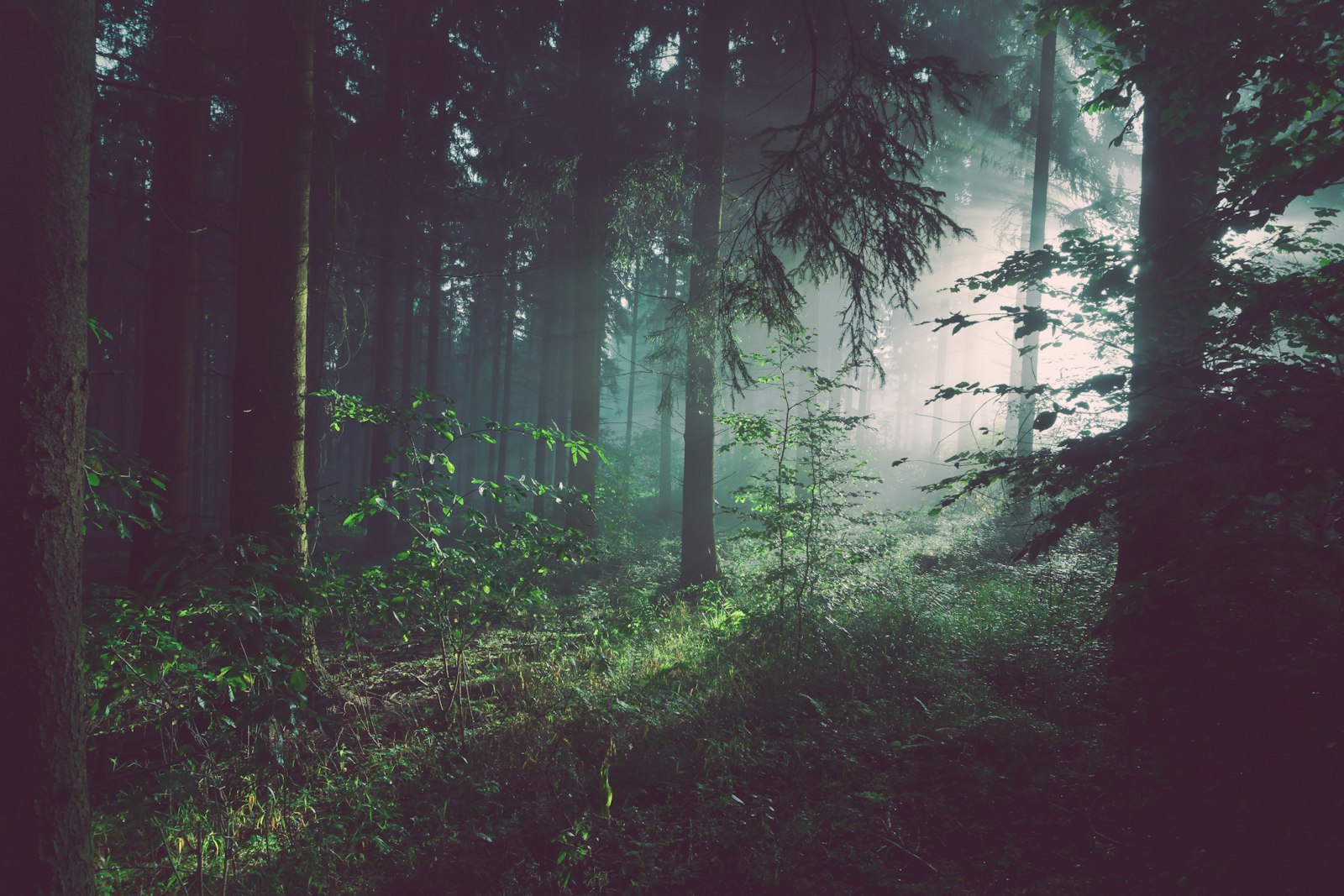
While she sniffed at the base of a tree, I looked at five things. Not glanced. Looked. The bark of the tree she was working on, and I would name the color in my head, gray-brown with green moss patches. A specific cloud through the canopy. A cluster of ferns at the base of a trunk. The particular rot-brown of a log going back into the ground. A bird I could not name on a low branch. By the time I had looked at five things, she was ready to move on.
Hearing: four sounds
As we walked, I named four sounds. Wind moving through the tops of the trees. Something small in the underbrush. A woodpecker working somewhere off to the left. A robin. By the time I had named four, I had walked maybe twenty feet.
Touch: three things
The leash in my hand, worn nylon, slightly textured. The morning air on my arms, cool but warming. The ground under my feet, soft and uneven with leaf litter.
Smell: two things
Whatever the morning offered. Cut grass. Rain on warm earth. The particular green smell the woods have after a wet night. This was the sense Kali was already an expert in, and I was the slow learner.
Taste: one thing
A small sip of warm water from the bottle I brought along. That counts. Taste is hard on a walk. The bottle handled it.
That was the whole practice. By the time I had moved through all five senses we were usually about ten minutes in. Then I either started over from the top or walked the rest of the loop with general awareness. Either worked.
What Shifted in Me
The first thing that shifted was the morning. I used to come home from her walk subtly stressed, ready to dive into work fast to make up the time. Once I stopped fighting the pace, I came home settled. My first hour of work, which had been choppy and reactive, got calmer. I got more done in the first two hours of the day than I used to get done in three.
The National Institutes of Health has a useful summary of how brief daily grounding exercises support stress regulation. I am one of millions of small data points confirming what they describe. A daily grounding practice changes the texture of the rest of the day.
The second thing that shifted was my relationship with her. The frustration went. I stopped looking at my watch on her walk and started looking at her. I noticed when she was interested in something. I noticed when she wanted to keep going. I noticed when her back legs were tired and it was time to turn for home. The walk became an actual exchange between two creatures paying attention to each other, instead of an outing I was waiting to finish.
The third thing is the one I did not fully understand until now. I used to think of the slowness as waste. It was not waste. It was extra time inside a relationship that was already winding toward its close, handed to me in fifteen-minute increments, every single morning, for years. I have those mornings now in a way I would not have if I had rushed her through them. That is the part I would most want another person to hear.
What I Think Shifted in Her
I cannot prove this. But I think Kali was happier on those walks than she had been the year before. She waited at the door in the morning. She pulled slightly toward her favorite sniff spots in a way she had not when I was hurrying her. She came home and slept deeply.
Veterinary behavior guidance is consistent that mental enrichment through scent work and sensory exploration matters for canine wellbeing, and matters more in senior dogs whose physical activity is dropping off. The American Kennel Club has a plain-language explanation of why sniffing does so much for a dog. A slow sniff-led walk is one of the highest-quality mental enrichment experiences a dog can have.
So the practice was doubly serving. It grounded me. It enriched her. The walk that used to feel like a tax on my morning was quietly serving two creatures who both needed exactly that kind of slow attention.
On Days When This Is Harder
This section is for you, if you have a slow old dog right now.
Some mornings you are in a bad mood. Some mornings you are genuinely late, for a 7:30 meeting or a medical appointment. Some mornings the weather is grim. The practice gets harder on those days.
What worked for me: shorten it. Commit to one full round of the five senses, which took about ten minutes at Kali’s pace, then head home. That is enough. Even a single round makes a noticeable difference to the rest of the morning. The National Center for Complementary and Integrative Health notes that regular practice is what the evidence supports, rather than occasional long sessions. A ten-minute grounded walk beats a perfect thirty-five-minute one you skip because you were in a hurry.
On the worst mornings I stopped trying to add the practice at all and just walked her at her pace. The walk was still slow time outside with a creature I loved. The mindfulness was a layer I added when I had the capacity for it. Skipping the layer did not ruin the walk.
A Last Note
The rug where she slept after our walks is still in the same spot. I have not moved it.
What I keep coming back to is the last stretch of mornings, when she was slowest and I was least in a hurry. I would sit on the stump halfway along the path because the sun was coming through warm and there was no reason not to. I would notice a shade of green on new maple leaves I had not paid attention to before, or how completely the trees close the road out of earshot. She would turn her face up toward mine when I sat down, as if to say, yes, this is good, let us sit.
If you have a senior dog, or any dog who walks slower than your idea of efficient, I would offer you this practice, and I would say it a little more plainly than I would have a month ago. Let their pace be the structure. Run the five senses on the slow loop. The walk you have been quietly frustrated with is very likely one of the most valuable windows of your day, hiding in plain sight.
Mine was. I did not know how much until it was over.
Sources
- What Is Grounding and How Can It Help You?, Cleveland Clinic.
- Mindfulness for Your Health, NIH News in Health.
- Meditation and Mindfulness: What You Need To Know, National Center for Complementary and Integrative Health, NIH.
- Why Does My Dog Sniff Everything?, American Kennel Club.
- PAWS with a Cause, the organization Kali worked for before she retired to my house.
Free 10-Minute Forest Bathing Meditation
Subscribe to Peacefully Proven and receive a free guided meditation to restore calm and clarity, delivered straight to your inbox.





Join the conversation and add your thoughts.