
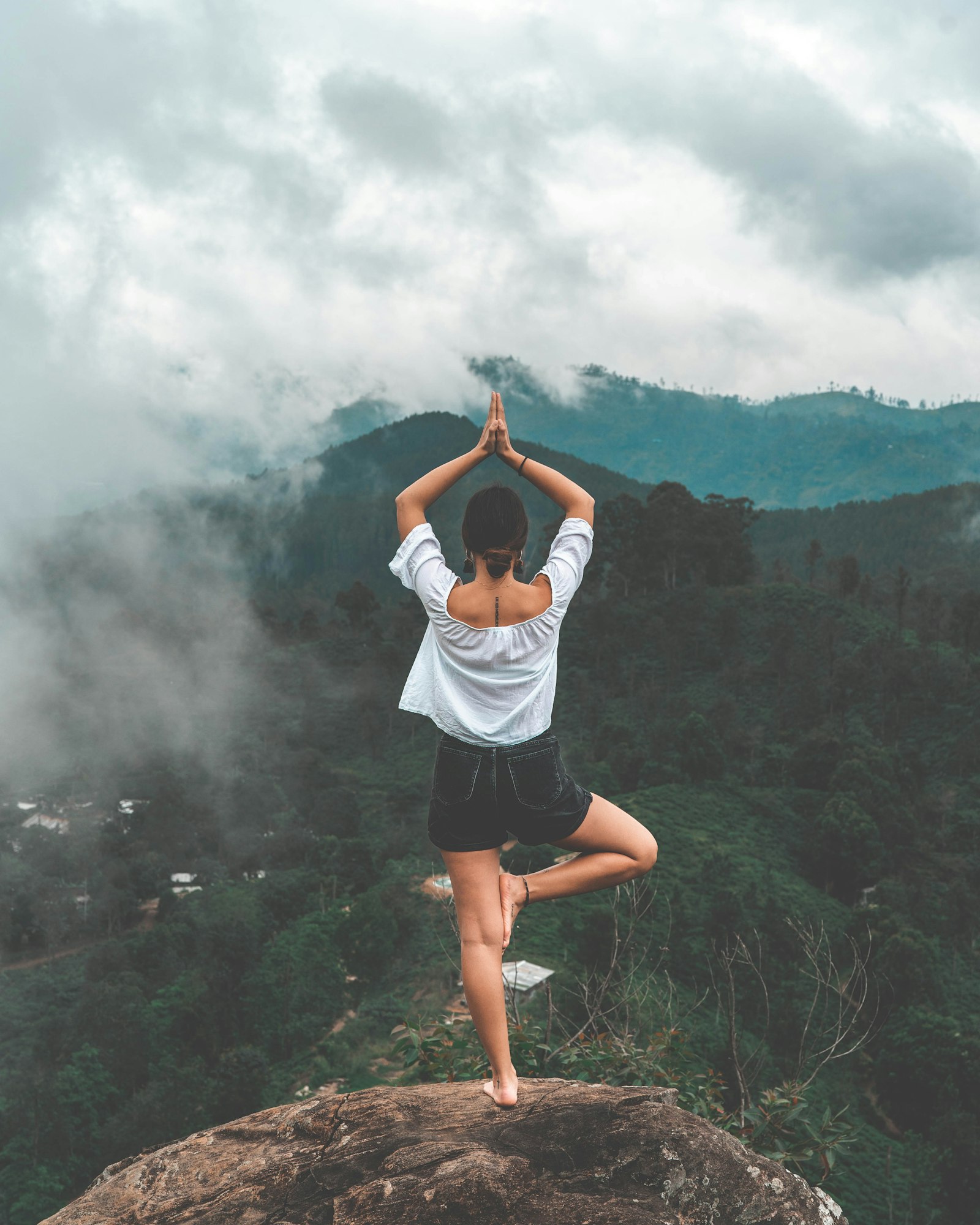
I do not travel a lot anymore, but a few times a year I get on a plane for something long enough to matter. A six-hour flight to a wedding. A long trip to see a friend across the country. A red-eye to a workshop. By the time I land I am stiff, dehydrated, my ankles look like someone else’s, and my sleep is shoved off its usual hours. At 58, on HRT, with a body that has its own opinions about hormones and travel, recovery does not happen by itself anymore.
Years ago I would push through this. I would land, drink coffee, back when I drank coffee, and try to act normal. The result was two or three terrible days of feeling like I was wading through water. Now I do something different. The day after I land, before I go back to my normal life, I lay out a yoga mat in my living room and do a twenty-minute restorative yoga sequence. Six shapes. Props. Slow breath. No flow.
This is the sequence. It is not a workout. It is the opposite of a workout. It is the most boring twenty minutes you will ever spend on a yoga mat, and it will undo more of the damage of a long flight than any amount of stretching or walking or hydrating alone. I share it because if you are a woman in midlife who occasionally has to fly, restorative yoga the day after may be the single most useful tool you can add to your travel routine.
In This Article
Key Takeaways
- Restorative yoga is held shapes supported by props, not active stretching or flow.
- The day after a long flight is when your body is most in need of gentle, parasympathetic input.
- Six shapes, held for two to four minutes each, is enough to make a real difference.
- Props matter; you do not need fancy ones, but you do need enough support.
- Slow nasal breathing under the shapes is what does most of the work.
Why Restorative, Not Vinyasa
The instinct after a long flight is to move. Walk it off, stretch it out, do a vinyasa class to “feel like yourself again.” I have tried that. For my body, it does not work the day after a flight. It activates a system that is already strained and adds more strain to an already-tired nervous system.
Restorative yoga works differently. The Mayo Clinic describes restorative yoga as a practice that uses props to fully support the body in held shapes so the nervous system can shift toward rest and recovery. The point is not to stretch deeply. The point is to be supported deeply enough that the body lets go. That letting-go is where recovery happens.
The National Center for Complementary and Integrative Health adds that gentle yoga practices have measurable benefits for stress, sleep, and chronic pain. For someone with a body recently spent in airline seats, recycled air, and shifted time zones, the gentle end of the spectrum is exactly where the help is.
I had to learn this through trial. The day-after-flight class at my old yoga studio used to be a slow vinyasa. I felt worse for it. Once I switched to restorative shapes at home, recovery went from two to three days down to about one. The body’s response is unambiguous.
The Props You Actually Need
You do not need a yoga studio’s worth of props. Here is what I use at home, all of which I bought once over the years for under a hundred dollars total or which were already in my house.
- A yoga mat or a folded blanket on carpet. Something to lie on that is more substantial than a hard floor.
- One bolster. A long firm cushion. Mine is a basic rectangular yoga bolster from a yoga supply store. A firm couch cushion or a tightly rolled comforter works in a pinch.
- Two firm blankets. Folded into rectangles. Wool or cotton, not fluffy. Folded so they form firm rectangular supports about the height of a brick.
- An eye pillow or a folded washcloth. Something with a little weight to put over your eyes.
- A wall. Any wall with enough clear space to put your legs up against it.
That is the whole prop kit. Nothing exotic. Set them out before you start the sequence so you are not getting up and down looking for the right blanket while you are trying to settle.
The 20-Minute Sequence
Six shapes. Held for two to four minutes each, depending on what feels right. Total time around twenty minutes including transitions.
Shape 1: Reclining bound angle, 3 minutes
Sit on the mat with the bolster lengthwise behind you. Slowly lie back so your spine and head are supported on the bolster. Bring the soles of your feet together and let your knees fall open wide, supported by the folded blankets under each knee so your inner thighs do not have to work. Arms relaxed at your sides, palms up.
This shape gently opens the chest and the front of the hips after hours of being folded into a seat. It looks lazy. It is profoundly useful.
Shape 2: Legs up the wall, 4 minutes
Move to a wall. Sit sideways against it, then swing your legs up the wall as you lie down on your back. Your seat can be against the wall or a few inches away. If your hamstrings are tight, scoot back further. Arms wide or hands on your belly.
This is the most useful shape in the entire sequence for post-flight recovery. Hours of sitting on a plane pool fluid in the legs. Legs up the wall, supported, returns that fluid toward the heart. My ankles are noticeably less swollen after this single shape. Harvard Health Publishing has noted that elevating the legs after sitting for long periods supports circulation and helps reduce travel-related swelling. Four minutes is enough.
Shape 3: Supported child’s pose, 3 minutes
Come off the wall. Set up on hands and knees. Bring your knees wide and your big toes touching, and slide the bolster lengthwise between your thighs. Lower your torso onto the bolster. Turn your head to one side, arms wherever they are comfortable. After ninety seconds, turn your head to the other side.
This releases the lower back and gives the body a sense of being held. For me it is the most parasympathetic shape in the sequence. The pressure of the bolster against the belly is calming in a way I did not expect the first time I tried it.
Shape 4: Supported reclining twist, 2 minutes each side
Lie on your back. Bring your knees toward your chest, then slowly let them fall to the right. Stack a folded blanket under your knees if they do not reach the floor easily. Extend your left arm to the side. Turn your head to the left if your neck allows.
After two minutes, slowly bring your knees back to center and let them fall to the left. Extend your right arm. Stay another two minutes.
Twists release the spine after long stillness and gently massage the digestive organs. Both of these matter after a flight.
Shape 5: Supported savasana with eye pillow, 4 minutes
Lie flat on your back. Place a folded blanket under your knees so your lower back rests easily on the mat. Place an eye pillow or folded washcloth over your eyes. Arms wide, palms up. Stay.
This is the integration shape. You have asked the body to release in several specific places; now you give it time to absorb. Four minutes is the minimum. If you have time, five.
Shape 6: Seated easy pose, hands on belly, 2 minutes
Slowly roll onto your right side, then push up to a seated position with crossed legs. Sit on the bolster or a folded blanket so your hips are higher than your knees. Hands on your belly. Eyes closed or soft gaze down. Notice how your breath has changed. Notice how your body feels different than it did twenty minutes ago.
This is the closing shape. It marks the end of the practice and the return to the rest of your day.
The Breath Underneath the Shapes
Underneath every shape, the breath is doing most of the work. The instruction is simple. Breathe through your nose, slowly. Make the exhale a little longer than the inhale. Maybe four counts in, six counts out. Maybe five in, seven out. The exact ratio does not matter as much as the principle: longer exhale than inhale.
The National Center for Complementary and Integrative Health has documented that slow, controlled breathing activates the parasympathetic nervous system and supports recovery from stress. After a long flight, the body has been in low-grade activation for hours. The longer exhale is the signal that the activation can end.
If your mind wanders during the shapes, and it will, return to the breath. Not as performance. As anchor.
What I Do After the Sequence
After the final shape I move slowly. I drink a large glass of water with a pinch of mineral salt, flights dehydrate me beyond what plain water seems to fix, and the small bit of salt helps me rehydrate properly. I eat a simple meal if I have not already. I go outside, even briefly, to get sunlight on my face.
Sunlight is the most important post-flight intervention beyond the yoga itself. The NIH’s National Institute of General Medical Sciences notes that morning sunlight is the strongest cue for resetting the circadian rhythm, which is exactly what a flight-shifted body needs. Twenty minutes of outdoor light, even in cloudy Michigan, helps my sleep clock reset by the second night.
The dogs come outside with me. They are happy I am home. I am happy I am home. That part is not a clinical intervention but it is part of the recovery.
Variations and Cautions
A few notes for adapting the sequence.
If you have any spine, knee, or heart conditions, ask your doctor before doing restorative yoga, especially the inversions (legs up the wall). Most people are fine; some are not, and your doctor knows.
If legs up the wall is uncomfortable, you can do the same shape with your legs on a couch seat or a chair instead of a wall. The fluid-return effect still works.
If you cannot lie flat comfortably, do every shape with extra support under the head and a bolster under the knees. There is no version of this practice that has to be done hard.
If you only have ten minutes, do legs up the wall for five and savasana for five. That is a valid abbreviated version. If you only have five minutes, just do legs up the wall. Even that is genuinely helpful.
A Last Note
The next time I fly is in about six weeks, for a business trip. I already know what I will do the morning after. I will get home tonight from the airport, sleep what I can sleep, and the next morning I will roll out my mat in the living room. The bolster, the blankets, the eye pillow are all in a basket by the bookshelf. The dogs will lie down nearby. I will do the six shapes. Twenty minutes later I will stand up and start the rest of my recovery from a much steadier place.
If you fly even a few times a year, I would offer this sequence to you. It is not a workout. It is not even really exercise. It is the practice of being supported enough to let go of what travel asks of the body. Try it after your next trip. Notice the difference. You may find, as I did, that the day after the flight is the day that matters most.
Sources
- Yoga: Fight stress and find serenity, Mayo Clinic.
- Yoga: What You Need To Know, National Center for Complementary and Integrative Health.
- Relaxation Techniques: What You Need To Know, National Center for Complementary and Integrative Health.
- Take care of your feet while traveling, Harvard Health Publishing.
- Circadian Rhythms, NIH National Institute of General Medical Sciences.
Free 10-Minute Forest Bathing Meditation
Subscribe to Peacefully Proven and receive a free guided meditation to restore calm and clarity, delivered straight to your inbox.





Join the conversation and add your thoughts.