

I do not drink coffee, tea, or anything caffeinated, which surprises people who assume that is how everyone powers through a stressful day. The truth is that caffeine and an already-overwhelmed mind are a bad combination for me, so over the years I have built a different toolkit entirely: a set of non-medication, caffeine-free tools I reach for when my mind gets loud and my to-do list gets longer than the day.
None of these replace professional help when it is needed, and I am a firm believer in getting that help when it is. But for the ordinary overwhelm of a busy life, these are the seven things that reliably bring me back down to earth. Most of them are free, and all of them are things I actually do.
In This Article
Key Takeaways
- You do not need caffeine, and for some of us it makes overwhelm worse.
- The fastest tools are the ones that work on the body: breath, movement, temperature, touch.
- Gratitude and meditation retrain where your attention lands over time.
- Saying no is a legitimate, underrated mental-health tool.
- The goal is a small toolkit you will actually use, not a perfect one.
1. Long-Exhale Breathing
This is the foundation, the one everything else is built on. When I feel the pressure rising, I breathe in slowly through my nose for a count of four and out for a count of six or eight. The extended exhale is what does the work, telling my nervous system it is safe to come down out of high alert.
I love it because it requires nothing. No app, no equipment, no privacy. Two or three minutes of slow breathing measurably shifts the body out of stress mode, and I can do it anywhere, which is exactly why it is the tool I use most.
2. Gratitude Journaling, Three Lines
Most mornings, and on hard evenings, I write down three things I am grateful for. Not a performance, not a full journal entry, just three honest lines. A warm shower. The dogs at my feet. A problem that turned out smaller than I feared.
What gratitude journaling does over time is gently retrain where my attention defaults. An overwhelmed mind scans for threats and unfinished business. The practice nudges it to also notice what is steady and good, and that shift in attention takes real pressure off the day.
3. A Phone-Free Walk Outside
Because I work from home and drive very little, getting outside has to be deliberate. So when the overwhelm builds, I leave the phone inside and take a slow walk, just me and whatever the Michigan sky is doing. The rhythm of walking settles the mind in a way sitting and worrying never will, and the time in nature does its own quiet work on top of that.
4. My Apollo Neuro for a Calm Signal
One of the few devices I genuinely rely on is my Apollo Neuro, a small wearable that delivers gentle vibrations meant to nudge the nervous system toward calm. I wear it at night to help me wind down, and on a tense afternoon I will switch on a calming setting while I keep working.
It is not magic, and not everything that works for me will work for everyone. But the soothing rhythm gives my body a steady, calming signal to focus on, and on overstimulated days that signal helps me settle faster than willpower alone.
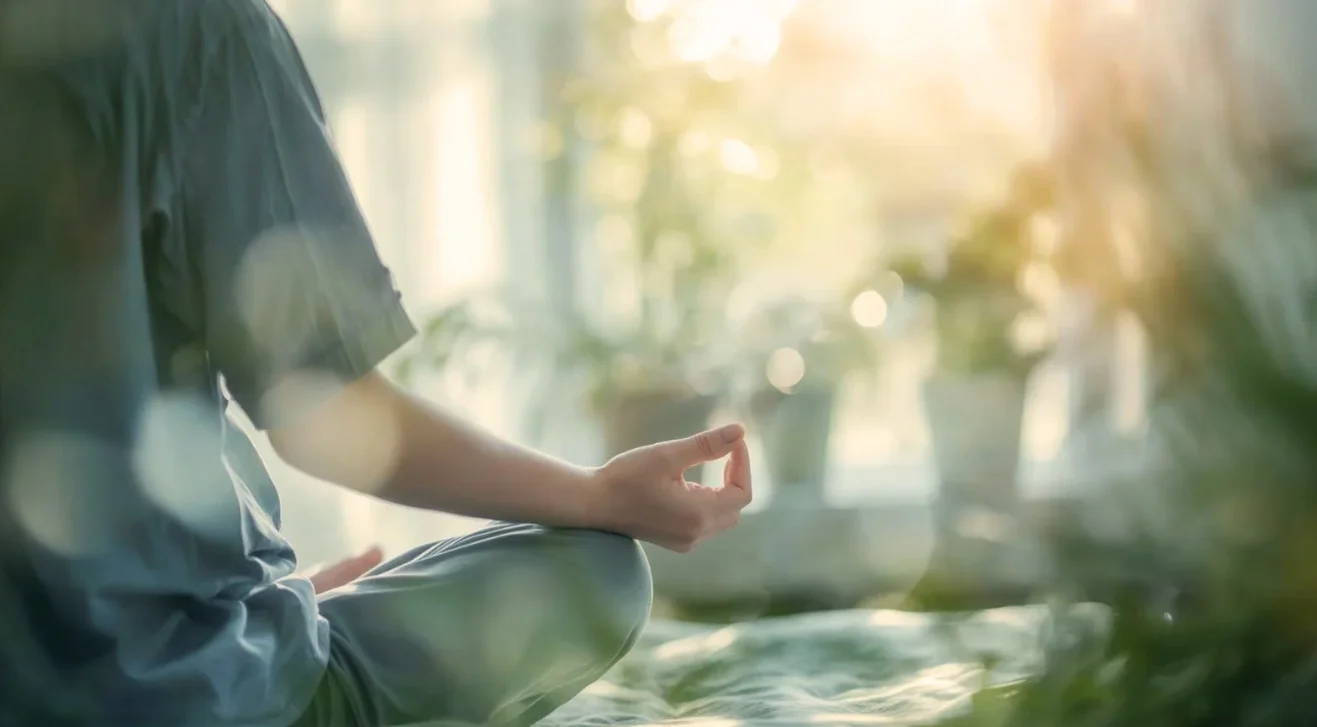
5. A Short Guided Meditation
When my thoughts are too loud to corral on my own, I hand the job to a guided meditation. I use the Headspace app, and even five minutes of a calm voice giving my mind something simple to follow can break the spiral. I also keep a short meditation in my evening routine, lying down with my legs elevated, which helps the whole day come down a notch before sleep.
The point is not to achieve a blank mind. It is to give an overwhelmed one a place to rest for a few minutes, and a guided track makes that much easier than going it alone.
6. Time With the Animals
This one is not in any clinical guideline, but it is one of my most reliable tools. When I am wound up, I sit down with the dogs and cats and just be with them for a while. The simple act of petting an animal slows my breathing and softens whatever I was bracing against.
There is something about their complete lack of urgency that resets mine. They are not worried about my inbox, and after a few minutes with them, I am a little less worried about it too.
7. A Well-Placed No
The last tool is the one I had to learn the hard way: protecting my own wellbeing by saying no. A lot of my overwhelm used to come from saying yes to more than I had room for. Now, when something would crowd out the quiet I need, I let myself decline it without a long apology.
A clear no is a real mental-health tool, not selfishness. Every time I use it, I am choosing to keep enough margin in my life that the other six tools have room to work. That margin, more than any single technique, is what keeps me steady.
Sources
- Caring for Your Mental Health, National Institute of Mental Health.
- Relaxation Techniques: What You Need To Know, National Center for Complementary and Integrative Health.
- Stress effects on the body, American Psychological Association.
- Spending time in nature can promote mental health, Harvard T.H. Chan School of Public Health.
The Free Subscriber’s Library Is Open
Join Peacefully Proven for a growing collection of free wellness tools, guides, and printables, plus a guided forest bathing meditation to begin. All yours, always free.






Join the conversation and add your thoughts.