
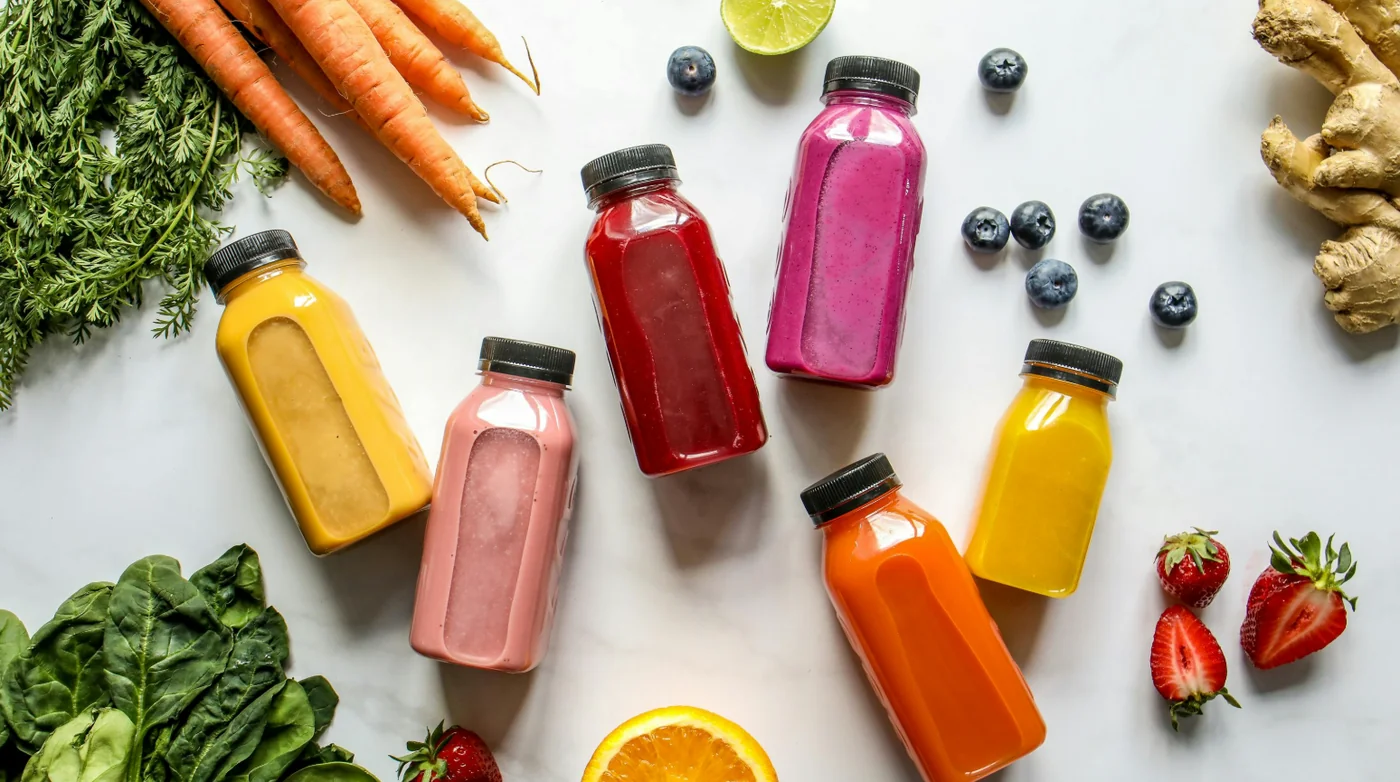
It’s 6:42 AM in late spring, and I’m in my Michigan kitchen with my own dogs milling around my ankles, waiting. Down the hall there is a momma dog and a litter of five-week-old puppies I am whelping for PAWS with a Cause, and the day ahead of me is feeding, cleaning, laundry, more cleaning, and staying ahead of a pile of small animals who have recently discovered that everything in the world can be chewed. I am in my fifties, vegan, on HRT for menopause, and I have learned the hard way that what I eat in this exact thirty-minute window will decide whether my knees ache by 2:00 PM and whether I’m still patient with people at 4:00 PM.
So I make the same breakfast every morning when there is a litter in the house. It’s a Kachava smoothie, but a specific version of one, anti-inflammatory ingredients added in deliberate ratios, finished with a few things that keep me steady for the long haul. I’m sharing it because so many of the volunteers I know skip breakfast or grab something fast, and then wonder why their bodies are in revolt by mid-afternoon. After a couple of years of refining this, I want to walk through what’s in it, why each piece is there, and what the science actually says about each ingredient.
This isn’t a fancy recipe. It takes me four minutes. But every ingredient is doing a job, and on the days I cut corners I feel it.
In This Article
- Why Breakfast Matters Differently Before a Long Volunteer Day
- The Kachava Base, Why I Started With It and Why I Stayed
- My Anti-Inflammatory Add-Ins, Ingredient by Ingredient
- The Liquid: Why Oat Milk Instead of Water
- The Full Recipe and Method
- The Small Side That Keeps Me Steady Past Lunch
- What Actually Changed in My Body
Key Takeaways
- A breakfast designed for inflammation and steady blood sugar protects your afternoon, not just your morning.
- Kachava gives me 25g of plant protein in one scoop plus a foundation of whole-food nutrients I’d otherwise have to assemble piecemeal.
- Tart cherry, ground flax, ginger, turmeric with black pepper, and frozen wild blueberries are the five anti-inflammatory add-ins that make a noticeable difference for me.
- Oat milk plus a tablespoon of nut butter adds the slow-burning fats that prevent the 10:30 AM crash.
- I pair the smoothie with a small piece of sourdough so I have a slow carb to lean on through the morning.
Why Breakfast Matters Differently Before a Long Volunteer Day
I used to think any breakfast was fine. A piece of toast, a banana, sometimes nothing. Then I started paying attention to the shape of my volunteer days. By mid-morning my knees would start to ache. By noon, I’d be foggy and short-tempered. By 3:00 PM I’d be promising myself I’d go to bed early, which I’d then break by 9:00 because I was so hungry I needed a second dinner. That pattern repeated for years before I connected it to what I was, and wasn’t, eating at 7:00 AM.
A volunteer day is physiologically different from a desk day. You’re standing for hours, lifting, bending, doing a low-grade version of physical labor while also doing a fair amount of emotional labor. Your nervous system is firing. Your joints are loaded. Your blood sugar is being asked to behave for nine hours, not three. According to the Academy of Nutrition and Dietetics, breakfasts that combine protein, fiber, and slow-digesting carbohydrates provide more stable energy across the morning than breakfasts heavy in refined carbs or skipped entirely. That principle, applied to a vegan diet, is exactly the architecture of what I now drink before a long day with a litter.
The other piece is inflammation. I am in menopause. My joints are not what they were at thirty-five. Estrogen has a known anti-inflammatory effect, and when it drops in midlife, baseline inflammation tends to rise. Harvard Health Publishing has been clear that diet is one of the most accessible levers for managing chronic, low-grade inflammation, and that a Mediterranean-leaning pattern, colorful plants, omega-3 sources, whole grains, consistently outperforms diets heavy in refined foods. My Saturday breakfast is essentially an attempt to deliver as many anti-inflammatory ingredients as possible in one glass before I head out the door.
The Kachava Base, Why I Started With It and Why I Stayed
I want to be honest: I was skeptical of Kachava for a long time. I assumed it would be overpriced powder marketing. What changed my mind was reading the ingredient list and noticing that it was actually trying to be a food, not a supplement disguised as one. Per their public product information at kachava.com, one scoop of their plant-based shake delivers 25 grams of plant protein (from pea, chia, sacha inchi, amaranth, and quinoa), 6 grams of fiber, a blend of greens, and additional whole-food micronutrients, all without dairy, soy, or added sugar of significance.
For me, on a whelping morning, that means I am not starting from zero. I am not trying to assemble protein from four sources, fiber from another two, and a greens powder I’d have to buy separately. Kachava is the floor. Then I build the anti-inflammatory house on top of it.
I use the chocolate flavor because it pairs cleanly with the add-ins I want and because it doesn’t taste artificially sweet. Vanilla works too. The flavor is honestly a preference question, and I’ve written more about my experience using it daily in Why I Love Kachava: My Honest Review After 6 Months, which gets into the financial math and the long-term sustainability of using it as a daily staple.
My Anti-Inflammatory Add-Ins, Ingredient by Ingredient
Here’s where the breakfast gets purposeful. Each of these has a specific job.
Tart cherry juice (two tablespoons)
Tart cherries are one of the most studied anti-inflammatory foods for joint and muscle recovery. A series of trials reviewed in PubMed Central have found that tart cherry concentrate reduces markers of inflammation and muscle soreness in active adults. I add two tablespoons of unsweetened concentrate. It’s tart, and it darkens the smoothie nicely, and it’s the single ingredient I notice most when I skip it, my hips feel different by mid-afternoon.
Ground flaxseed (one tablespoon)
Ground flax is my plant-based omega-3 source. The Harvard T.H. Chan School of Public Health Nutrition Source notes that ground flax provides alpha-linolenic acid (ALA), an omega-3 fatty acid, plus lignans with antioxidant activity and fiber. Important point: it has to be ground, not whole, or your body can’t access the nutrients. I keep a small bag of ground flax in the freezer to preserve the oils and add a tablespoon to almost every smoothie I make.
Fresh ginger (a knuckle-sized piece, peeled)
Ginger has been used medicinally for thousands of years and has accumulating modern evidence for anti-inflammatory and anti-nausea properties. The Mount Sinai health library notes that ginger contains compounds called gingerols that are anti-inflammatory and antioxidant. I grate about a teaspoon of fresh ginger directly into the blender. It gives the smoothie warmth and a slight bite that, paired with chocolate and cherry, works surprisingly well.
Turmeric with black pepper (a half teaspoon plus a pinch)
Turmeric’s active compound, curcumin, is one of the most-studied anti-inflammatory plant compounds. Johns Hopkins Medicine notes that curcumin has anti-inflammatory effects and is being studied for joint pain, mood, and brain health applications. The trick is that curcumin has poor bioavailability on its own, until you pair it with piperine, the compound in black pepper, which can dramatically increase absorption. I add a half teaspoon of turmeric and a small pinch of black pepper. You don’t taste the pepper. You do feel the effect over time.
Frozen wild blueberries (a half cup)
Frozen wild blueberries are smaller, darker, and significantly higher in antioxidants than regular cultivated blueberries. They thicken the smoothie, add a punch of polyphenols, and bring natural sweetness that means I don’t need to add anything else for flavor. The PubMed Central literature on blueberries and inflammation is robust, anthocyanins, the compounds that make them dark blue-purple, are associated with reduced markers of oxidative stress.
The Liquid: Why Oat Milk Instead of Water
I used to blend Kachava with water. It worked. It was thin and the flavor was muted. Then I switched to oat milk and I’m not going back. Oat milk does two things water doesn’t: it adds a small amount of beta-glucan, a soluble fiber linked to lower cholesterol and steadier blood sugar, and it gives the smoothie a creamy density that makes it feel like an actual breakfast, not a drink.
I use unsweetened organic oat milk. The unsweetened part matters because so many oat milks have added sugar that turns a healthy smoothie into a sugar bomb. Read the label. The first ingredient should be oats, and total sugar should be under 4 grams per cup.
I also add a tablespoon of almond butter or sunflower butter. Healthy fats slow gastric emptying and keep blood sugar more stable across the morning. The Harvard Nutrition Source consistently emphasizes that unsaturated fats are central to a heart-healthy, inflammation-friendly diet. One tablespoon adds enough fat to make the smoothie carry me cleanly to lunch, which during a litter is whenever the puppies give me twenty minutes.
The Full Recipe and Method
Here’s the exact recipe, as I make it on those mornings.
Ingredients:
- 1 scoop chocolate Kachava
- 1 cup unsweetened organic oat milk
- 1/2 cup frozen wild blueberries
- 1 tablespoon ground flaxseed
- 1 tablespoon almond butter (or sunflower butter)
- 2 tablespoons unsweetened tart cherry juice concentrate
- 1 teaspoon freshly grated ginger
- 1/2 teaspoon turmeric
- A small pinch of black pepper
- 2 ice cubes
Method:
Put everything in the blender. Pulse a few times to break up the frozen berries, then blend on high for about 45 seconds, until the texture is thick but pourable. Pour into a glass. Drink slowly, this is not a chug-and-go. I usually take about ten minutes with it at the kitchen counter while I look in on the puppies.
The Small Side That Keeps Me Steady Past Lunch
The smoothie alone, on a heavy day, runs out of steam by about 11:00 AM. So I always pair it with a small piece of toasted sourdough and a thin smear of avocado, sometimes with a sprinkle of sea salt. This adds a slow carbohydrate and a bit more healthy fat, and the combination of the smoothie plus the sourdough side reliably gets me to a lunch at 12:30 without hitting a wall.
Sourdough is worth a note. Traditional sourdough fermentation breaks down some of the gluten and lowers the glycemic response compared to standard bread. The American Academy of Family Physicians notes that fermentation processes can affect the glycemic impact of grain-based foods, and in my own experience, real sourdough sits differently in my body than commercial bread. I get a small loaf from a local Michigan baker every Friday and that’s what I eat through the weekend.
What Actually Changed in My Body
Six months of litters into making this specific breakfast, here’s what I noticed.
My knees, which used to ache by mid-afternoon, stopped doing that. I could still feel the work, I was on my feet for hours, but the deep ache wasn’t there. I attribute most of this to the combination of turmeric, ginger, tart cherry, and omega-3s working over months, not just one morning.
My mood stayed steadier. By 3:00 PM I used to be impatient with the slower-moving parts of the day, the third load of laundry, the fourth cleanup. Now I have noticeably more bandwidth in the late afternoon. The Academy of Nutrition and Dietetics has noted in their resources on diet and mental health that steady blood sugar and adequate omega-3 intake are both associated with mood stability. I am not surprised this carried over to the second half of my volunteer day.
My recovery was faster. Sunday mornings, I used to wake up feeling like I’d been hit by a truck. Now I wake up tired but not wrecked. The inflammation I was carrying into Sunday seems to have come down with the dietary changes.
None of this is a miracle. It’s the slow accumulation of doing one small thing well, every week. That’s what food as medicine actually looks like in real life. Not a single magic ingredient, but a deliberate stack of choices, repeated.
A Last Note
Tomorrow, like most mornings with a litter in the house, I’ll stand at my kitchen counter at 6:42 AM and make this exact smoothie. I’ll eat my sourdough side. Then I’ll go down the hall and start the day with the smoothie still in my system, knowing I’ve given my body what it needs for the hours ahead.
If you’re a volunteer, a caregiver, or just someone with long days ahead, vegan or not, I’d offer this as a starting framework: protein, fiber, omega-3s, anti-inflammatory plant compounds, a slow carb on the side. Build your version. Don’t skip breakfast. Don’t pretend a banana is enough. Your future self at 3:00 PM will thank you, and so will whoever you’re showing up for.
Sources
- Breakfast: Balance and Energy, Academy of Nutrition and Dietetics.
- Foods That Fight Inflammation, Harvard Health Publishing.
- Flaxseed, Harvard T.H. Chan School of Public Health Nutrition Source.
- Turmeric Benefits, Johns Hopkins Medicine.
- Ginger, Mount Sinai Health Library.
- A Systematic Review of the Effects of Tart Cherry Consumption on Inflammation, PubMed Central.
- Ka’Chava Plant-Based Whole Body Meal, Kachava.com.
The Free Subscriber’s Library Is Open
Join Peacefully Proven for a growing collection of free wellness tools, guides, and printables, plus a guided forest bathing meditation to begin. All yours, always free.






Join the conversation and add your thoughts.