

I do not drink alcohol. I do not drink coffee or any caffeinated tea. I do not even drink the so-called gentler caffeinated things like green tea or matcha: they wire me, mess with my sleep, and worsen the hot flashes I am still managing through menopause. For a long time this meant my “evening drink” was a glass of plain water, which is fine but is not, as anyone who has tried to wind down with plain water can confirm, a ritual.
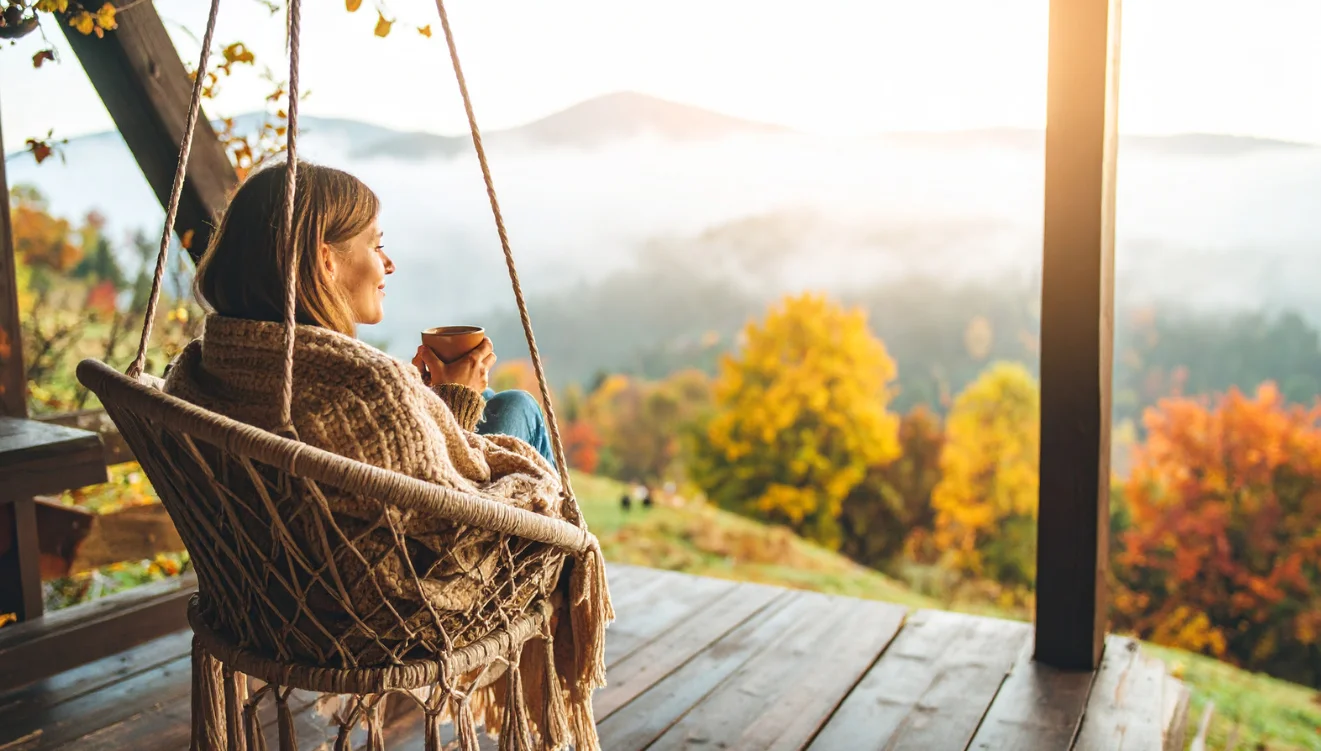
About fourteen months ago I started building a non-alcoholic, non-caffeinated mocktail for the end of the day. It uses adaptogens and a few specific herbs and juices, and over the months I have refined the recipe to something I genuinely look forward to. More importantly, I have built a ritual around it. I make the mocktail on my porch, watch the sunset, and let the day end. The drink and the porch and the sunset together have become a small mindfulness practice that has done more for my evenings than any sleep app I have tried.
This is the recipe, the ritual, and the honest reasoning behind both. I want to say up front: I am not a clinician, and adaptogens have real considerations that anyone in menopause or on hormone therapy should think through with a doctor. I will walk you through what I drink and why, what I learned from research, and what I would suggest you check before adopting any of it.
In This Article
Key Takeaways
- An evening drink can be a ritual without containing alcohol or caffeine.
- Adaptogens are a category of herbs with real research behind them, but they are not all interchangeable.
- Tart cherry juice, mineral water, and a citrus brightener are the structural base.
- The ritual is half of the practice. The drink alone is just a drink.
- Anyone on HRT or other medications should clear adaptogens with a clinician first.
Why an Evening Drink Without Alcohol or Caffeine
The cultural script for “winding down” is: pour a glass of wine, sit somewhere comfortable, decompress. I get the appeal. I just cannot do it without paying a price the next day. Even a single glass of wine disrupts my sleep, worsens my hot flashes, and makes me more anxious by Wednesday. The National Institute on Alcohol Abuse and Alcoholism has documented that alcohol affects women differently after age forty, and that even moderate use can compound sleep and mood issues in menopause. That has been my lived experience too.
Coffee and caffeinated tea are similarly off the table for me. My nervous system already runs on the active side, and caffeine adds activation I cannot afford. By the time the sun is setting, I want the body coming down, not having one more conversation with an alkaloid.
What I needed was something that filled the same psychological role (the ritual, the holding-something-pleasant, the cue to the body that the day is closing) without the chemical cost. That is what I built.
What Adaptogens Actually Are (Briefly)
Adaptogens are a category of plants and fungi that have been used traditionally to help the body respond to stress without overstimulating or sedating it. The most-studied include ashwagandha, rhodiola, reishi mushroom, holy basil, and a few others. The National Center for Complementary and Integrative Health describes ashwagandha specifically as having modest but real research support for stress-related symptoms, with notes about safety considerations for some populations.
The research on adaptogens is real but variable. Some have strong evidence; others have weak evidence. The Mayo Clinic has written that herbal supplements should be treated as actual interventions, with attention to dosing, sourcing, and interactions. I do not think of my mocktail as medicinal. I think of it as a daily-dose ritual that includes a few well-studied herbs at conservative quantities, in a base of regular food ingredients.
Two specific adaptogens are in my mocktail: reishi mushroom powder and ashwagandha powder. Both are well-studied. Both have been used traditionally for evening contexts (reishi for sleep support, ashwagandha for stress modulation). Both are at conservative doses. I will name what I use below.
The Recipe I Drink Now
Here is the version I have landed on after fourteen months of iteration. Makes one full glass tumbler, my evening serving.
Ingredients
- 4 oz organic tart cherry juice (unsweetened)
- 4 oz cold sparkling mineral water
- 1/2 teaspoon ashwagandha powder (organic)
- 1/2 teaspoon reishi mushroom powder (organic)
- Juice of half a lemon (or a quarter of an orange in winter when I want a softer flavor)
- 1 teaspoon raw maple syrup (Michigan, when I can get it)
- A small pinch of sea salt
- Ice
Method
In a glass tumbler, whisk the ashwagandha and reishi powders into the tart cherry juice until smooth. The powders are stubborn; a small whisk or a milk frother works best. Add the maple syrup and the pinch of salt and whisk again. Squeeze in the lemon (or orange). Add ice. Top with sparkling mineral water. Stir gently. Garnish with a wedge of the lemon if you like.
That is the whole recipe. Takes about two minutes. The whisking is part of the ritual; do not skip it.
Why Each Ingredient Is in There
I built the recipe one ingredient at a time, with a reason for each. Here is the reasoning.
Tart cherry juice
Tart cherry juice is the base for a specific reason: there is meaningful research on tart cherry juice and sleep. Multiple studies, including ones cited in the Sleep Foundation’s overview of nutritional sleep aids, suggest that tart cherry juice contains naturally occurring melatonin and tryptophan, and that regular consumption modestly improves sleep duration and quality in adults. I am not asking it to do the job of a medication, but it is a useful daily input.
Ashwagandha powder
Ashwagandha has the strongest research base among adaptogens for stress-related symptoms in adults. The NCCIH notes studies suggesting modest benefits for stress and anxiety, with notable safety considerations including potential interactions with thyroid medications and a warning against use during pregnancy. I take a small daily dose in the mocktail, half a teaspoon of powder, which translates to roughly 1.5 grams. This is on the lower end of the studied range. I have my doctor’s awareness that I take it, given my HRT.
Reishi mushroom powder
Reishi has traditional use as an evening adaptogen, sometimes called the “mushroom of immortality” in Chinese medicine. The research is less robust than for ashwagandha but suggests it may support immune modulation and stress response. I use a half teaspoon, about 1.5 grams of powder. The flavor is earthy and a little bitter; the tart cherry juice masks it well.
Lemon (or orange)
The citrus is for brightness and to cut the earthy adaptogens. Vitamin C does not hurt. The acid also makes the powders integrate more cleanly into the juice.
Maple syrup
A teaspoon of raw maple syrup balances the tartness and the bitter notes from the mushroom and ashwagandha powders. I prefer it to honey here because the flavor is more rounded. Michigan produces excellent maple syrup if you can get it locally.
Sea salt
A small pinch of sea salt does something to the flavor that I cannot quite name. Brightens everything. Try it. If you do not want salt, leave it out.
Sparkling mineral water
The bubbles are important. The drink becomes a different beverage with sparkling water than with flat. There is something about effervescence that makes the drink feel like a treat. A still water version is fine but lower-ritual.
Ice
Cold drinks are part of why this works as an evening ritual for someone in menopause. Cold drinks help me with hot flashes. If you do not have hot flashes, you can do this room temperature.
The Porch Ritual
The drink alone is good. The drink as part of a ritual is great. Here is what I actually do, which has become as important as the recipe itself.
Around the time the sun is starting to set, which in Michigan ranges wildly across the year, I close my laptop for the day. If I am mid-task I write a one-line note for tomorrow morning and put the laptop away. The closing of the laptop is the start of the ritual.
I go to the kitchen and assemble the mocktail. I do this without rushing. The whisking, the squeezing, the salting, the topping with bubbles. It takes about two minutes. The two minutes are part of the practice. I do not stir it together carelessly.
I take the tumbler out to the front porch. I sit in my chair. I have the same chair, the same side table, the same view of my yard and the trees beyond it. The dogs sometimes come out. The cats sometimes watch from the window. I sip slowly. I watch the light change. I do not look at my phone.
The whole ritual takes between fifteen and thirty minutes depending on how slowly I am drinking and how interesting the sunset is. Some Michigan sunsets are not interesting, flat gray skies, no color. The practice happens anyway. The sunset is not the point. The pause is the point.
When the drink is gone, I take the tumbler back to the kitchen, rinse it, and the day is closed. Whatever I do for the rest of the evening (read a book, watch something gentle, sit with the dogs) happens from a different state than it would have if I had skipped the porch.
Cautions and Who Should Check First
I have to say this part clearly. Adaptogens are real plants with real effects. They are not pixie dust. A few groups should absolutely not adopt this without talking to a clinician first.
Anyone on thyroid medication. Ashwagandha can affect thyroid function, particularly in people on levothyroxine. The NCCIH explicitly notes this interaction.
Anyone on hormone therapy (including HRT). I am on HRT and I cleared this with my doctor before adopting it. Adaptogens can interact with hormone-modulating medications in ways that vary by person.
Anyone on immunosuppressants. Reishi can affect immune function. If you are on immunosuppressants for any reason, this is a clinician conversation.
Anyone who is pregnant or breastfeeding. Most adaptogens are not recommended in these contexts.
Anyone with a serious chronic condition or on multiple medications. Adaptogens can interact with a number of common medications. Cleveland Clinic has noted that herbal adaptogens should be treated as supplements with real pharmacology and discussed with a clinician who knows your other medications.
I am not anti-caution. I am the person who cleared this with my doctor before adopting it daily. Please do the same.
A Last Note
The sunset tonight is supposed to be at 8:54 PM. I will close my laptop around 8:30. I will make the mocktail. I will take it to the porch. The dogs will join me or not. The cats will watch through the window. The sky will do whatever it is going to do over my yard.
If you are someone who does not drink alcohol, does not drink caffeine, and feels like you have lost the cultural script for what an evening ritual looks like, I would offer you this. Build a recipe that nourishes you. Mix it slowly. Take it somewhere outside. Sit in the same chair for the same fifteen minutes every night. Watch the light change. Let the day close.
The drink matters. The ritual matters more. Together, they have made my evenings into something I look forward to rather than a long stretch I have to fill with willpower. After fourteen months, the practice has become non-negotiable. Tonight, like most nights, the tumbler will be on the porch railing, the lemon wedge will catch the last light, and the day will end the way I want days to end.
Sources
- Ashwagandha, National Center for Complementary and Integrative Health.
- What Are Adaptogens and What Do They Do?, Cleveland Clinic.
- Tart Cherry Juice and Sleep, Sleep Foundation.
- Herbal supplements: What to know before you buy, Mayo Clinic.
- Alcohol and Aging, National Institute on Alcohol Abuse and Alcoholism.
Free 10-Minute Forest Bathing Meditation
Subscribe to Peacefully Proven and receive a free guided meditation to restore calm and clarity, delivered straight to your inbox.




Join the conversation and add your thoughts.